
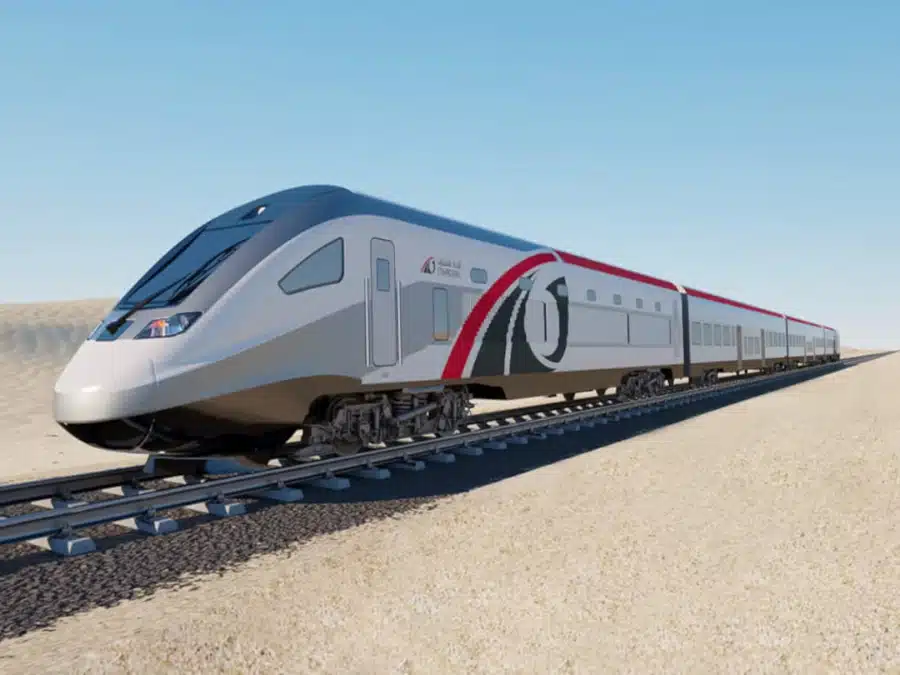
The Train That Changes Everything
For decades, the Abu Dhabi to Dubai commute has meant one thing: a car on Sheikh Zayed Road, a journey of 90 minutes on a good day, and a daily drain on time, fuel, and productivity that hundreds of thousands of UAE residents absorbed as an unavoidable cost of living between the country’s two major cities. In 2026, that calculus changes permanently. Etihad Rail’s passenger service is launching this year, connecting 11 cities across all seven emirates on a 900-kilometre network, with the flagship Abu Dhabi to Dubai route completing in 57 minutes at speeds of up to 200 kilometres per hour.
Eng. Mohammed Alshehii, Chief Projects Officer at Etihad Rail, confirmed that the service will officially launch in 2026, with the first phase connecting key locations including Mohamed Bin Zayed City in Abu Dhabi, Jumeirah Golf Estates in Dubai, University City in Sharjah, and the Al Hilal area in Fujairah. The phased approach is deliberate, prioritising the highest safety standards from day one in line with global best practices. Ten of the 13 trains in the fleet have already arrived in the UAE and been tested and certified to international safety and quality standards.
The Network at a Glance
The full Etihad Rail passenger network is one of the most ambitious transport projects in the UAE’s history, connecting addresses that have never previously been served by intercity rail.
| Route | Journey Time |
| Abu Dhabi to Dubai | 57 minutes |
| Dubai to Fujairah | 69 minutes |
| Abu Dhabi to Fujairah | 105 minutes |
| Abu Dhabi to Al Ruwais | 70 minutes |
| Full Station Network | Operational Phase |
| Mohamed Bin Zayed City, Abu Dhabi | Phase 1 |
| Jumeirah Golf Estates, Dubai | Phase 1 |
| Fujairah (Al Hilal) | Phase 1 — first fully completed station (51,900 sqm) |
| Sharjah (University City) | Phase rollout |
| Al Dhaid | Phase rollout |
| Al Dhannah | Phase rollout |
| Al Faya | Phase rollout |
| Madinat Zayed | Phase rollout |
| Mezaira’a | Phase rollout |
| Al Mirfa | Phase rollout |
| Al Sila | Phase rollout |
Once fully operational, the network is expected to serve between 10 and 36.5 million passengers annually, with first and last-mile connectivity provided through integrated links to metro systems, buses, taxis, e-hailing platforms, and cycling facilities at each station.
What the Trains Are Like: On-Board Experience
A Khaleej Times media team rode the train from Fujairah Station toward Al Bithnah Bridge in May 2026, providing the first independent passenger-level account of the on-board experience. The cabins are designed around practical comfort rather than theatrical luxury — generous legroom, Wi-Fi and power at every seat, foldable tray tables, overhead storage, dedicated space for larger baggage, and family-seating configurations that allow parents and children to travel together without separation. Each train carries up to 400 passengers at full capacity.
Two cabin classes are available across the network: Comfort and Premium. Adhraa Almansoori, Executive Director of Commercial at Etihad Rail, was clear about the intent behind both: “Whether someone is in Comfort or Premium, the same care has gone into seating, legroom, connectivity and the overall feel of the cabin. The aim is for it to feel consistent and dependable from one journey to the next.”
Fujairah Station, the first fully completed passenger station in the network at approximately 51,900 square metres, offers a preview of the wider station experience: cream-and-grey interiors, wide glass panels, clear signage, automated barriers, parking, accessibility features, ticketing machines readable by QR codes and automated scanners, and dedicated staff assistance throughout. The station includes food and drink options, a car park, special waiting areas, and a taxi rank.
What Etihad Rail Means for Abu Dhabi Property Values
Transport infrastructure of this scale does not operate in parallel to the property market. It reshapes it. The opening of Etihad Rail’s passenger service in 2026 creates a direct and measurable change in the residential value proposition of communities positioned near stations — and the implications for Abu Dhabi’s property market are significant enough that any serious buyer or investor should factor them into every community-level decision made from this point forward.
Mohamed Bin Zayed City, Abu Dhabi’s Phase 1 station, is located near Dalma Mall in one of the emirate’s most established mid-market residential communities. It serves a large population of families and professionals who currently commute to Dubai by car. The arrival of a 57-minute rail service to Dubai from this address transforms its liveability proposition for dual-city residents — the demographic that has historically driven the strongest rental demand in Abu Dhabi’s mid-market segment. Properties within close proximity to Etihad Rail stations globally have consistently demonstrated measurable value appreciation in the period surrounding a new line’s opening, as the market prices in reduced commute times, lower transport costs, and an expanded employment catchment.
The Abu Dhabi corridor stretching westward from Mohamed Bin Zayed City through Al Mirfa to Al Sila gains a connectivity premium that road-based access alone cannot deliver — and that premium is now a permanent feature of any property investment analysis in those communities. Working with a leading real estate brokerage in Abu Dhabi that tracks corridor-level demand shifts in real time is the most direct way to identify where that premium is not yet reflected in current asking prices.
The High-Speed Rail Dimension: 30 Minutes by 2030
The 57-minute Abu Dhabi to Dubai journey is not the ceiling of what this infrastructure will deliver. In January 2026, Etihad Rail unveiled a separate high-speed rail project linking Abu Dhabi and Dubai at speeds of up to 350 kilometres per hour, targeting a journey time of 30 minutes. That project sits on a longer development horizon, but its announcement confirms that the UAE is treating the current network as a foundation rather than a final product.
Al Maktoum International Airport will eventually have a dedicated Etihad Rail station — a connection that further reinforces the investment case for communities along the Abu Dhabi to Dubai corridor as Al Maktoum’s expansion into one of the world’s largest airports proceeds through the coming decade. The convergence of rail connectivity and airport proximity along this corridor is a demand driver combination that very few residential addresses anywhere in the UAE can currently claim.
Conclusion
Etihad Rail’s 2026 passenger launch is a generational infrastructure event for the UAE and a direct, measurable demand driver for residential communities along its Abu Dhabi corridor. A 57-minute Abu Dhabi to Dubai journey eliminates the single greatest friction point in dual-city living. An annual passenger target of up to 36.5 million creates a permanent, high-frequency transit spine between the UAE’s two largest economic centres. A high-speed project targeting 30 minutes by the end of the decade confirms that this infrastructure is being built for the next forty years. For property investors who understand that connectivity is the most durable residential demand driver available, the Etihad Rail corridor is now one of the most important lenses through which to evaluate any Abu Dhabi acquisition.
Etihad Rail confirmed the passenger service will launch in 2026, with the first phase connecting Mohamed Bin Zayed City in Abu Dhabi, Jumeirah Golf Estates in Dubai, and Fujairah. The remaining eight stations will follow in phases. For investment guidance along the rail corridor, speak to Abu Dhabi’s most trusted real estate agency.
The Abu Dhabi to Dubai journey takes 57 minutes at speeds of up to 200 kilometres per hour, reducing the current 90-plus minute road commute by 30 to 40 percent. A separate high-speed project targeting 30 minutes at 350km/h was announced in January 2026 on a longer development timeline.
Two classes are available: Comfort and Premium. Both feature generous legroom, Wi-Fi and power at every seat, overhead storage, and family-seating configurations. Official ticket prices have not been confirmed. For investment guidance on properties along the Etihad Rail corridor, consult an Abu Dhabi real estate investment advisor.
The 11-station network includes Mohamed Bin Zayed City (Abu Dhabi), Jumeirah Golf Estates (Dubai), Fujairah, Sharjah, Al Dhaid, Al Dhannah, Al Faya, Madinat Zayed, Mezaira’a, Al Mirfa, and Al Sila — connecting addresses from Al Sila in the west to Fujairah on the east coast. The majority of stations are within the Abu Dhabi emirate.
Rail-adjacent communities consistently demonstrate measurable value appreciation around new line openings as reduced commute times, lower transport costs, and expanded employment catchment are priced in by the market. Mohamed Bin Zayed City’s Phase 1 station and the broader Abu Dhabi corridor now carry a permanent connectivity premium. Get expert market positioning advice from an award-winning property consultancy in Abu Dhabi.
Join The Discussion