
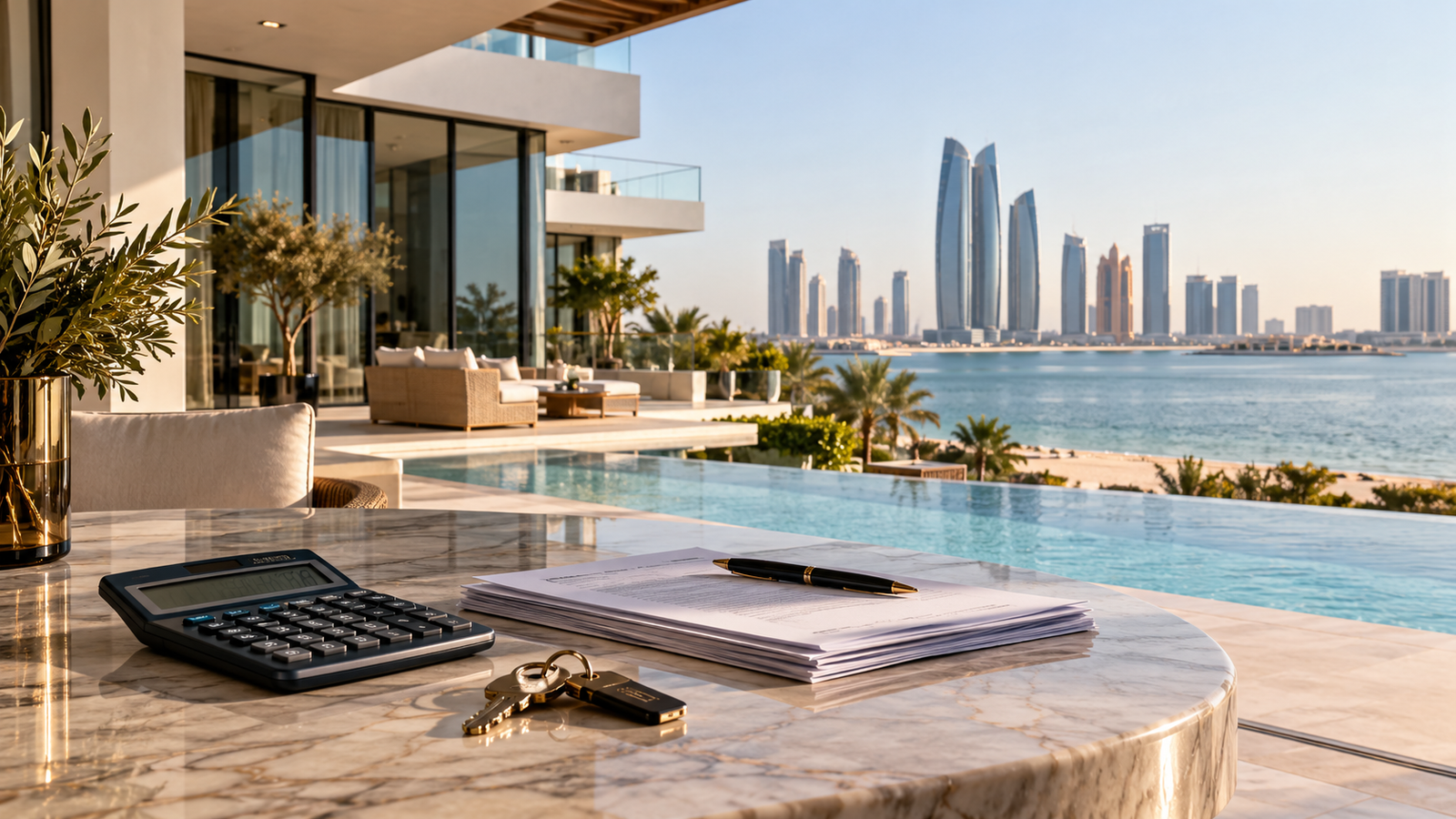
A waterfront villa on Saadiyat Island, an exclusive residence on Jubail Island, or a luxury apartment overlooking the Arabian Gulf may represent an exceptional lifestyle opportunity. But behind every property price is a financial picture that buyers should understand before making an investment.
In Abu Dhabi’s luxury real estate market, the advertised price is only the beginning. Government registration fees, brokerage commissions, mortgage arrangements, community service charges, maintenance, insurance, and furnishing can all influence the total cost of ownership.
A property listed for AED 10 million does not necessarily mean the buyer’s total financial commitment will be limited to AED 10 million.
Some expenses arise during the purchase process, while others continue throughout ownership. Understanding both is essential for protecting capital, planning cash flow, and making informed property decisions.
For buyers and investors considering luxury real estate in Abu Dhabi in 2026, this guide explores the financial responsibilities behind property ownership and explains how to prepare for them.
The Purchase Price Is Just the Beginning
Luxury property prices across Abu Dhabi reflect much more than the size of a residence.
Location, architectural design, waterfront access, plot size, privacy, construction quality, community infrastructure, and exclusivity can significantly influence property values.
On Saadiyat Island, beachfront residences and luxury villas offer access to cultural destinations and coastal living. Yas Island combines premium residential developments with entertainment, leisure, and established community facilities.
Jubail Island appeals to buyers seeking spacious villas surrounded by natural landscapes, while Hudayriyat Island offers emerging luxury residential opportunities.
However, two similarly priced properties can have very different long-term ownership expenses.
An older villa may require extensive maintenance or renovation, while a new apartment with premium shared facilities may carry substantial annual service charges.
Buyers exploring luxury properties in Abu Dhabi should therefore examine more than the listed price. The property’s condition, recurring expenses, and long-term suitability are equally important.
A successful purchase begins with understanding the full financial commitment rather than focusing exclusively on the asking price.
Government Registration Fees: An Essential Upfront Expense
Property registration is one of the main additional expenses associated with purchasing real estate in Abu Dhabi.
The Abu Dhabi Real Estate Centre (ADREC) mortgage calculator uses a transaction fee equivalent to 2% of the property value for illustrative purposes.
However, Abu Dhabi’s wider registration framework provides for sale registration fees within a 1% to 4% range, depending on the applicable rules and transaction category.
The precise amount payable must be confirmed for the specific purchase.
For example, applying a 2% illustrative registration fee to an AED 10 million property produces a figure of AED 200,000.
This example demonstrates how government transaction costs can become substantial when purchasing high-value real estate. It should not be treated as a universal fee quotation or confirmation of which party must pay it.
Depending on the transaction, buyers may also encounter administrative expenses, documentation charges, legal or conveyancing fees, and mortgage registration costs.
These expenses can differ between developer sales, completed residential resales, and off-plan transactions.
Before signing a sale and purchase agreement, buyers should request a written breakdown of the applicable government charges, related administrative expenses, and each party’s payment responsibilities.
Brokerage Commission and the Cost of Professional Representation
Real estate brokerage is another important component of the purchasing process.
Abu Dhabi’s real estate brokerage regulations establish a commission of 2% for sale and purchase contracts, subject to a maximum of AED 500,000.
The applicable contractual arrangements, responsible paying party, and any VAT on brokerage services should be clearly understood before completing a transaction.
On a hypothetical AED 10 million property, a 2% brokerage commission would amount to AED 200,000 before any applicable VAT.
However, the amount payable by an individual buyer depends on the actual contractual arrangement and transaction circumstances.
A secondary-market purchase involving a brokerage agency may have different arrangements from a direct purchase from a developer.
Clear documentation is essential to avoid misunderstandings during the closing process.
Professional representation can also help buyers evaluate available properties, understand transaction requirements, and review market comparisons before committing to a purchase.
Mortgage Financing: Understanding the Full Financial Commitment
Mortgage financing can make a luxury property purchase possible without paying the entire purchase price upfront.
However, buyers must consider more than the monthly mortgage instalment.
The UAE Central Bank establishes maximum loan-to-value ratios based on factors including the borrower’s nationality, property value, intended occupancy, and whether the purchase involves a first home, subsequent property, or off-plan development.
Under the published framework, eligible expatriates purchasing their first owner-occupied property valued above AED 5 million may qualify for financing of up to 70% of the property value.
For a hypothetical AED 10 million property, this could mean a maximum mortgage of AED 7 million and a buyer contribution of AED 3 million.
The AED 3 million represents part of the property’s purchase price, not an additional transaction charge.
Mortgage borrowers may also encounter bank arrangement fees, valuation expenses, mortgage registration charges, insurance requirements, and financing interest or profit payments.
These expenses vary between lenders and according to the individual financing agreement.
A mortgage also creates a long-term repayment obligation. Buyers should therefore assess affordability using the total financing cost, not simply the advertised interest or profit rate.
Before purchasing, obtaining mortgage pre-approval and a detailed financing illustration can help establish a realistic acquisition budget.
The Ongoing Expense Many Luxury Buyers Overlook: Service Charges
After the purchase is completed, the financial responsibilities of property ownership continue.
Annual service charges are among the most important recurring expenses, particularly in luxury residential developments offering extensive shared facilities.
These charges generally contribute towards the maintenance and operation of common areas, security services, landscaping, shared swimming pools, fitness centres, elevators, and other community infrastructure.
A luxury apartment with premium shared amenities may have different service charge obligations from a detached villa in a gated residential community.
For buyers comparing properties, the annual service charge can materially affect the cost of ownership.
It is important to request the latest approved service charge information and review any outstanding liabilities associated with the property.
Service charges should also be distinguished from maintenance expenses within the privately owned residence.
A villa owner, for instance, may need to pay separately for private swimming pool maintenance, garden care, irrigation systems, and air-conditioning servicing.
A property with an attractive purchase price but high annual expenses may be less financially suitable than another property with more manageable recurring costs.
Furnishing and Interior Design: Turning a Luxury Property Into a Home
The cost of preparing a property for occupation is another area that can be underestimated.
Not every luxury residence is delivered fully furnished or equipped to the buyer’s preferred standard.
A newly completed apartment may require furniture, curtains, lighting, kitchen appliances, and interior accessories.
A large villa may involve considerably more extensive requirements, including outdoor furniture, landscaping, customised wardrobes, smart-home technology, and interior design services.
For buyers planning to occupy the property personally, furnishing costs depend on lifestyle preferences and the existing specifications.
For investors, furnishing decisions should be based on realistic tenant demand and the expected financial benefits.
A furnished luxury residence may appeal to certain rental segments, but furnishing costs do not automatically translate into proportionately higher rental income.
Understanding the property’s intended use helps establish an appropriate fit-out budget without unnecessary expenditure.
Maintenance: The Responsibility Behind Luxury Living
Luxury real estate often includes sophisticated building systems, high-quality finishes, and extensive indoor and outdoor facilities.
Maintaining these features requires ongoing attention.
Regular expenses may include air-conditioning servicing, plumbing repairs, electrical inspections, waterproofing, appliance replacement, and general property upkeep.
For villas, swimming pools, gardens, irrigation systems, outdoor lighting, and private landscaping can create additional responsibilities.
Even newly constructed properties may require maintenance, while older residences can involve more extensive repairs or renovation.
Before purchasing a completed property, buyers should consider commissioning an appropriate technical inspection.
This can help identify potential defects, ageing equipment, water leakage, or other issues that may affect future costs.
Setting aside a property-specific maintenance reserve can also help owners manage unexpected repairs.
The appropriate reserve depends on the size, condition, age, and technical complexity of the residence. There is no single maintenance percentage suitable for every luxury property.
Insurance and Protection of a High-Value Asset
Property insurance is another consideration for buyers seeking to protect a valuable real estate investment.
Different insurance products offer different levels of coverage.
Building insurance generally addresses specified risks affecting the physical structure, while contents insurance may provide protection for furniture, appliances, and personal belongings.
Owners renting their properties may also consider landlord insurance, depending on the protections available.
For financed purchases, lenders may impose specific insurance requirements.
Buyers should evaluate coverage limits, exclusions, excess amounts, and whether certain building protections are already included within community arrangements.
Luxury properties with private pools, expensive fittings, or valuable interior finishes may require particular attention when assessing insurance coverage.
An appropriate insurance policy should reflect the property’s actual risks and replacement requirements rather than being selected solely on the basis of its annual premium.
Property Management and the Responsibilities of a Landlord
For investors purchasing property primarily to generate rental income, professional property management may be another recurring expense.
Property management services can include tenant communication, rent collection, lease administration, maintenance coordination, inspections, and assistance with property handovers.
These services may be particularly relevant to overseas investors or owners managing several properties.
However, management charges differ depending on the service provider and the scope of the agreement.
Investors should confirm whether tenant placement, leasing commissions, maintenance work, renewals, and other administrative services are included or charged separately.
Effective property management can help owners organise day-to-day responsibilities, but its cost must be considered when evaluating overall investment performance.
Rental Income vs Real Returns: The Difference That Matters
A luxury property may generate attractive rental income, but the amount received from tenants is not necessarily the amount an investor retains.
Rental income must be considered alongside the expenses of ownership.
Service charges, maintenance, insurance, property management, leasing costs, and potential periods without a tenant can reduce the property’s net return.
Vacancy is particularly important.
Even a well-located luxury residence may remain unoccupied between tenancies or during maintenance work.
For example, an apartment advertised with an annual rental potential of AED 400,000 may not generate the full amount if it remains vacant for part of the year.
A responsible financial assessment should therefore include realistic assumptions about occupancy, operating expenses, and ongoing capital requirements.
Gross rental yield is calculated by dividing annual rental income by the property’s purchase price and multiplying by 100.
Net rental yield provides a more detailed picture by considering recurring operating expenses and the capital invested in acquiring the property.
Financing costs and capital repayments also need to be considered separately when evaluating actual cash flow.
For serious investors, sustainable net income and long-term asset quality are more useful indicators than headline rental figures alone.
Understanding VAT and Property-Related Taxes
The VAT treatment of real estate transactions in the UAE depends on the type of property and the nature of the transaction.
According to the Federal Tax Authority, the first qualifying supply of a newly constructed residential property within three years of completion is generally zero-rated.
Subsequent supplies of residential properties are generally exempt from VAT.
Commercial property transactions can be subject to different rules, with the standard VAT rate generally applying to taxable commercial property supplies.
Importantly, the VAT treatment of a residential property sale should not be confused with the tax treatment of related services.
Brokerage, maintenance, property management, and certain other services may attract VAT even where the property transaction itself is exempt or zero-rated.
Buyers should therefore confirm the tax treatment of each relevant expense rather than assuming that all costs associated with residential ownership are VAT-free.
For complex transactions or purchases involving business entities, professional tax advice may be appropriate.
Off-Plan or Ready Property: A Different Financial Journey
The timing of expenses can vary significantly depending on whether the buyer purchases an off-plan development or a completed residence.
Off-plan properties typically involve payments linked to a developer’s agreed schedule.
Buyers may begin with a booking payment followed by construction-linked instalments and a final payment at handover.
Applicable registration charges, financing arrangements, and eventual furnishing expenses should also be considered.
While payment plans may spread the purchase price across several instalments, they do not eliminate the total financial commitment.
Buyers must evaluate developer credibility, construction timelines, contractual obligations, and their ability to complete future payments.
Completed properties may require a larger immediate financial commitment, particularly when purchased through a conventional mortgage or cash transaction.
However, ready properties allow buyers to inspect their physical condition and may provide an opportunity for earlier occupation or rental, depending on availability.
They can also involve renovation or maintenance expenses that are less apparent from the listing price.
For investors comparing off-plan properties in Abu Dhabi with completed residences, the decision should consider cash flow, property condition, payment structure, and long-term objectives.
Neither option is universally cheaper or more profitable.
A Practical Example: Buying a Luxury Villa for AED 10 Million
Consider an investor interested in purchasing a completed luxury villa with an agreed price of AED 10 million.
The buyer may initially focus on the property price, but a realistic acquisition plan requires a broader view.
Using ADREC’s illustrative 2% transaction fee produces a registration cost of AED 200,000, subject to confirmation of the actual applicable fee and payment responsibility.
If a 2% brokerage commission applies, this would represent a further AED 200,000 before applicable VAT, depending on the transaction arrangement.
A buyer using mortgage financing may need to contribute several million dirhams towards the purchase price, together with relevant bank and registration costs.
The property’s future operating budget must then consider service charges, private maintenance, insurance, furnishing, and other ongoing commitments.
The following table illustrates the different financial categories that should be reviewed before proceeding.
| Expense | What the buyer should verify |
|---|---|
| Purchase price | AED 10 million |
| Registration | Applicable government fee and payment responsibility |
| Brokerage | Applicable commission, contract terms and VAT |
| Mortgage | Down payment, loan expenses and total financing cost |
| Service charges | Latest approved annual charges |
| Furnishing | Existing specifications and fit-out requirements |
| Maintenance | Property condition and anticipated repairs |
| Insurance | Required coverage and annual premium |
| Property management | Contract scope and fees, if applicable |
| Rental vacancy | Realistic occupancy assumptions for investors |
This example is intended to illustrate the budgeting process rather than provide a universal quotation.
The actual total cost will depend on the individual property, transaction documents, financing agreement, and applicable regulations.
A Smarter Way to Evaluate a Luxury Property Purchase
Before committing to a high-value property, buyers should assess expenses across three distinct stages.
Before purchase, the priority should be verifying the asking price against comparable transactions, confirming ownership documentation, understanding government charges, reviewing brokerage arrangements, and establishing financing eligibility.
At completion, attention should shift towards final settlement amounts, inspections, insurance, outstanding service charges, utilities, and any immediate furnishing or renovation requirements.
During ownership, the focus should be on service charges, maintenance, insurance, property management, and the realistic financial performance of the asset.
Separating these stages helps buyers understand how much capital they need initially and what ongoing commitments they will face.
It also makes comparisons between different properties more meaningful.
A waterfront apartment with extensive facilities may suit one investor, while a private villa with more direct maintenance responsibilities may better match another buyer’s priorities.
The right choice depends not simply on the property price, but on the financial and practical suitability of the entire ownership experience.
Final Thoughts: Luxury Is an Investment, but Clarity Is an Advantage
Purchasing luxury real estate in Abu Dhabi is about more than acquiring an impressive address.
It involves understanding the financial responsibilities associated with obtaining, maintaining, and potentially leasing a valuable property.
From government transaction charges and mortgage financing to annual service fees and long-term maintenance, every expense contributes to the property’s true cost of ownership.
For buyers considering Saadiyat Island, Yas Island, Jubail Island, Hudayriyat Island, or other premium residential destinations, proper financial planning can make the difference between an attractive purchase and an investment that genuinely aligns with their objectives.
At NAS Luxury Real Estate, we believe informed property decisions begin with transparency. Understanding both the opportunities and the obligations of ownership helps buyers approach Abu Dhabi’s luxury market with greater confidence.
The true value of a luxury property is not determined by its price tag alone, but by what it costs to own, maintain, and hold over time.
Additional costs can include government registration fees, brokerage commission, mortgage charges, legal services, furnishing, and insurance. Owners should also consider recurring service charges, maintenance, and property management expenses. Buyers can explore available residential options through NAS Luxury Real Estate while reviewing the individual costs associated with each property.
ADREC’s mortgage calculator uses an illustrative transaction fee of 2% of property value. However, Abu Dhabi’s registration framework provides a wider fee range and transaction-specific rules. Buyers should confirm the applicable government charge and the responsible paying party before completing a purchase.
Service charges may apply to residential properties within managed developments and communities. They generally support common-area maintenance, security, and shared facilities. The amount varies by property and development, so buyers should request the latest applicable service charge information.
The answer depends on the buyer’s financial objectives, budget, lifestyle preferences, and expected ownership costs. Villas and apartments can differ significantly in maintenance responsibilities, rental demand, service charges, and resale characteristics. For further perspectives on Abu Dhabi property investment, visit Ayman Sadieh’s website.
Investors should consider the purchase price, transaction expenses, annual rental income, maintenance, service charges, insurance, management fees, and expected vacancy. Evaluating net rental yield and cash flow alongside property condition and long-term demand provides a more complete picture than gross rental yield alone.
Join The Discussion