
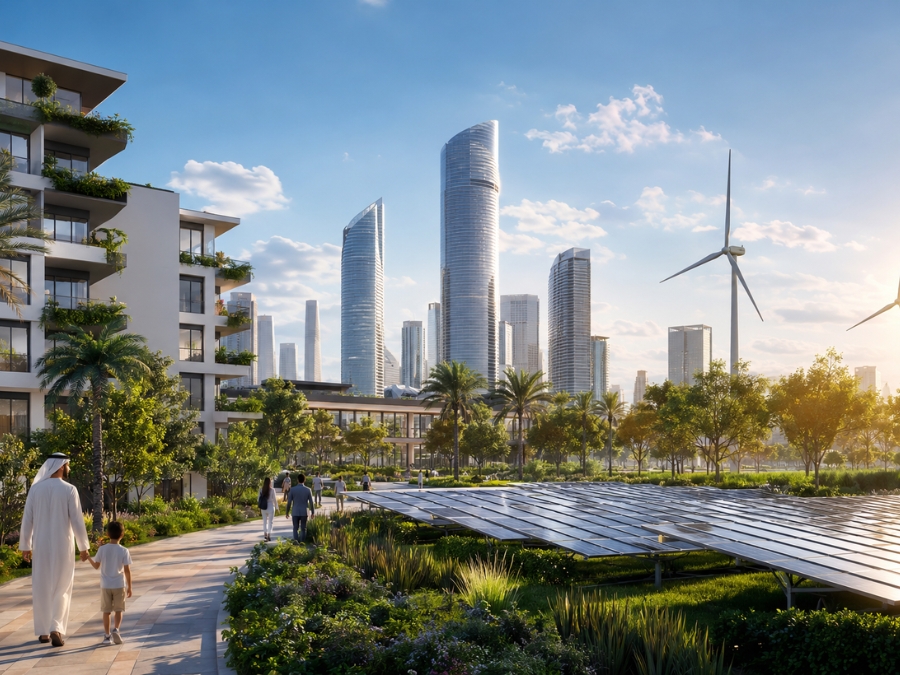
Sustainability as Investment Infrastructure
Aldar Properties published its 2025 Sustainability Report under the headline “Designing Places, Empowering Communities” — a title that does more than describe a corporate document. It describes a development philosophy that is now producing measurable, independently verified outcomes across environmental performance, community investment, and responsible governance. For property buyers and investors evaluating Aldar’s communities in Abu Dhabi, these outcomes are not peripheral. They are indicators of long-term asset quality, tenant retention, regulatory alignment, and institutional credibility that directly affect the value and resilience of every home Aldar delivers.
The report covers four pillars: creating sustainable places, creating societal value, creating responsible legacy, and empowering people. Each pillar contains data points that translate directly into investment-relevant conclusions — and several of those conclusions challenge the assumption that ESG and financial performance are separate conversations.
Creating Sustainable Places: The Environmental Numbers
The sustainability performance data confirmed in the 2025 report represents year-on-year improvement across every environmental metric Aldar tracks, measured against a 2023 baseline:
| Metric | 2025 Performance |
| Scope 1 emissions reduction | 6% versus 2023 baseline |
| Scope 2 emissions reduction | 9% versus 2023 baseline |
| Construction waste recycled | 96% |
| New developments receiving Pearl 3 Estidama | 100% |
| 34MW solar project (45 locations) | Completing mid-2025 |
| First-year CO2 reduction from solar | 23,000 tonnes |
| 20-year projected CO2 reduction from solar | 560,000+ tonnes |
The 96% construction waste recycling figure is the operational sustainability data point that carries the most direct investment relevance. It reflects a procurement and site management discipline that reduces material costs, limits regulatory exposure, and positions Aldar’s construction programme as compliant with the UAE’s circular economy targets — which are increasingly influencing planning approvals and community certification timelines.
The 100% Pearl 3 Estidama compliance across all new developments is equally significant. Estidama, Abu Dhabi’s built environment sustainability rating system, sits at the intersection of planning regulation and market differentiation. Pearl 3 compliance is not a marketing badge — it is a legal and technical standard that requires measurable performance across energy, water, indoor environment quality, and materials. Every new Aldar home delivered in 2025 and beyond meets this standard as a baseline, not as an exception. For buyers comparing Aldar communities against non-rated alternatives, that certification represents a quantifiable quality floor that protects both the resident experience and the long-term asset value. Exploring Aldar’s certified sustainable communities in Abu Dhabi through a specialist agency is the most direct way to identify which developments carry the strongest green credentials alongside the strongest financial fundamentals.
Creating Societal Value: Community Investment at Scale
The societal value data in Aldar’s 2025 report confirms that the company’s community investment programme operates at a scale that goes well beyond conventional corporate social responsibility:
| Metric | 2025 Figure |
| Direct community investment | AED 18 million |
| Investment in local economy (In-Country Value Programme) | AED 30 billion |
| Disability-Friendly City Framework | Launched 2025 |
| Aldar Customer Experience Academy | Launched 2025 |
The AED 30 billion invested in the local economy through Aldar’s In-Country Value Programme is the headline figure — and it requires contextualisation. In-Country Value programmes in the UAE are structured frameworks requiring companies to prioritise UAE-based suppliers, contractors, and service providers across their supply chains. Aldar’s AED 30 billion figure represents the cumulative value of procurement directed through UAE-registered entities, generating employment, skills development, and economic activity that circulates within the communities where Aldar builds.
For property investors, this figure matters because it signals a developer whose economic footprint is deeply embedded in the UAE’s productive economy — not a company extracting margin from a local market while sourcing inputs globally. The launch of the Disability-Friendly City Framework and the Aldar Customer Experience Academy — designed to embed hospitality-led, inclusive service standards across all community interactions — are operational commitments that translate directly into the quality of living experience in Aldar-managed communities and the retention rates of tenants who choose to stay.
Creating Responsible Legacy: The Green Finance Credentials
Aldar’s financial sustainability profile is among the strongest of any real estate developer in the MENA region, and the 2025 report’s responsible legacy data confirms continued institutional recognition of that position:
| ESG Metric | 2025 Figure |
| Green sukuk raised (cumulative) | USD 790 million |
| DJSI score | 67 points |
| MSCI ESG rating | A |
| Sustainalytics risk score | Low risk |
| Contractors receiving sustainability training | 100% |
| Net zero target | Scope 1, 2, and 3 emissions by 2050 |
| Science-aligned 2030 interim target | Net zero Scope 1 and 2 by 2030, 45% Scope 3 reduction |
The USD 790 million raised through green sukuk is the most direct signal of institutional capital market confidence in Aldar’s sustainability credentials. Green sukuk proceeds are ring-fenced under Aldar’s Green Finance Framework — governed by a Second Party Opinion from Sustainalytics — and directed specifically toward sustainability-accredited real estate within Aldar’s portfolio. The fact that Aldar has raised this volume at competitive spreads confirms that global fixed income investors have independently assessed and validated the quality of its sustainability programme.
The DJSI score of 67 and the MSCI ESG rating of A represent independent third-party assessments that place Aldar among the leading global real estate companies on sustainability performance — not among UAE real estate companies, but among all real estate companies assessed globally across both indices. For long-term investors who factor ESG risk into their portfolio construction, an Aldar community is an asset backed by a developer whose institutional rating reduces the regulatory and reputational risk profile of the investment over a multi-decade horizon.
What the 2025 Report Means for Abu Dhabi Property Buyers Right Now
The practical investment implications of Aldar’s 2025 Sustainability Report operate across three timeframes simultaneously. In the short term, 100% Pearl 3 Estidama compliance across new developments means every Aldar home delivered in the current cycle is built to a lower-energy, lower-water, higher indoor quality standard than non-certified alternatives — reducing the operational cost of ownership for buyers and the utility burden for tenants. In the medium term, the 34MW solar programme targeting 23,000 tonnes of annual CO2 reduction across 45 locations will progressively reduce service charge exposure for residents in communities where Aldar manages the utility infrastructure.
In the long term, the DJSI and MSCI ratings, the USD 790 million green sukuk track record, and the 2030 net zero Scope 1 and 2 commitment signal a developer whose access to institutional capital — and therefore whose ability to deliver the next generation of community development — is structurally protected from the regulatory tightening that less sustainable developers will face as UAE and global carbon frameworks tighten through the decade.
For buyers evaluating which Abu Dhabi developer to back for the next property cycle, Aldar’s sustainability credentials are not a soft differentiator. They are a hard investment indicator, and one that the 2025 report quantifies with the precision that institutional investors require. For personalised guidance on selecting the right Aldar community for your investment objectives, consulting a best real estate consultant in Abu Dhabi who understands both the financial and sustainability dimensions of the market is the most productive starting point.
Conclusion
Aldar’s 2025 Sustainability Report documents a developer operating at the intersection of commercial scale and genuine environmental and social accountability. Ninety-six percent construction waste recycling, 100% Pearl 3 Estidama compliance, USD 790 million in green sukuk, AED 30 billion in local economy investment, a DJSI score of 67 and an MSCI A rating — these are not aspirational targets. They are independently verified outcomes from the year that just closed. For Abu Dhabi property buyers who understand that the quality of a developer’s sustainability programme is a proxy for the quality of every decision that developer makes, the 2025 report delivers a clear verdict: Aldar is building communities designed to hold their value, their certifications, and their communities’ quality of life for the long term.
The report covers four pillars: creating sustainable places, societal value, responsible legacy, and empowering people. Key highlights include 96% construction waste recycling, 100% Pearl 3 Estidama compliance for all new developments, USD 790 million in green sukuk, AED 30 billion invested in the local economy, and ESG ratings of DJSI 67 and MSCI A. Explore Aldar’s certified communities through a top-rated property brokerage in Abu Dhabi.
Pearl 3 Estidama is Abu Dhabi’s built environment sustainability rating standard. Aldar achieved Pearl 3 compliance across 100% of its new 2025 developments, confirming that every new community meets verified benchmarks for energy efficiency, water use, indoor environment quality, and sustainable materials — reducing operational costs for owners and tenants over the life of the asset.
Aldar holds a DJSI score of 67 and an MSCI ESG rating of A, placing it among the leading global real estate companies on sustainability performance across both indices. These ratings signal to institutional capital that Aldar’s long-term risk profile is lower than less sustainable developers — protecting asset values in communities Aldar builds and manages. For a full investment analysis, speak with a trusted real estate investment advisor in Abu Dhabi.
Aldar has raised a cumulative USD 790 million through green sukuk issuances under its Green Finance Framework, governed by a Sustainalytics Second Party Opinion. Proceeds are directed specifically to sustainability-accredited real estate assets within Aldar’s portfolio, with proceeds from each issuance structured to support the company’s net zero Scope 1 and 2 emissions target by 2030.
The AED 30 billion In-Country Value investment channels procurement through UAE-registered entities, supporting local employment and economic activity in the communities Aldar builds. The 34MW solar programme across 45 locations will reduce CO2 by 23,000 tonnes annually. The Disability-Friendly City Framework and Customer Experience Academy improve the quality and inclusivity of community living standards directly. Browse Aldar’s full portfolio of sustainable residential developments in Abu Dhabi to identify the right community for your goals.
Join The Discussion