
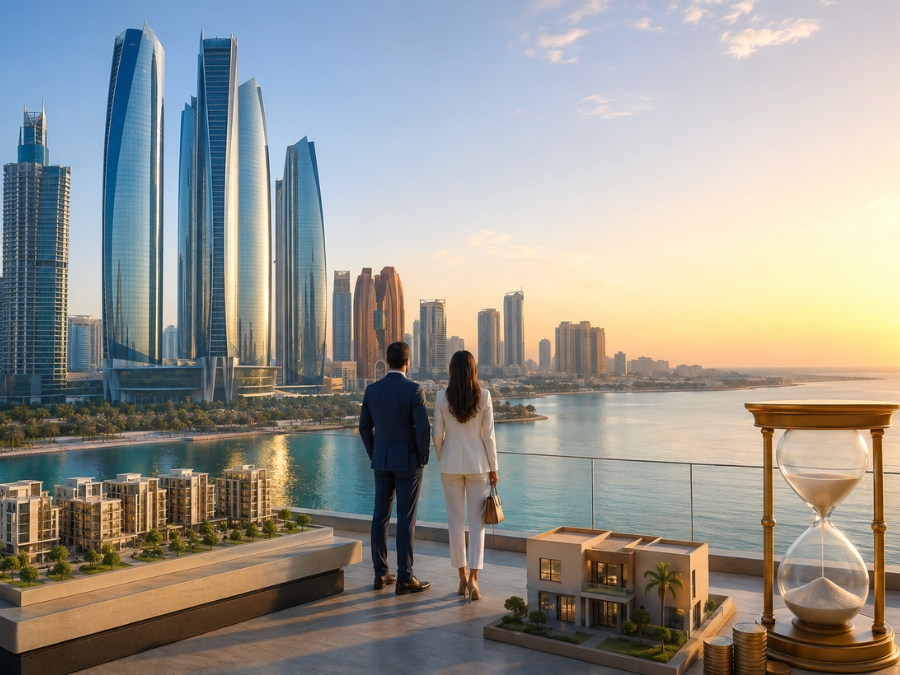
A Market in Transition — Not in Decline
Something has quietly shifted in the UAE’s property market in 2026, and serious buyers in Abu Dhabi are beginning to notice it. For the first time in several years, conditions are tilting away from sellers — not dramatically, and not permanently, but enough to create a window that disciplined, long-term investors recognise as meaningful.
This is not a market correction in the traditional sense. Prices have not fallen. Abu Dhabi posted record residential transaction values in Q1 2026, and CBRE’s UAE Real Estate Market Review confirmed that the emirate’s structural fundamentals remain firmly intact. What has changed is the tone of the market — and for buyers willing to act with a long-term mindset, that change carries real significance.
The geopolitical backdrop — including regional conflict and the associated uncertainty — has introduced caution that was absent in 2023 and 2024. But caution, in a market this structurally sound, is not the same as weakness. It is, for the right buyer, an entry point.
Why Abu Dhabi Holds Firm Where Others Soften
The buyers’ market narrative emerging in 2026 is largely concentrated in Dubai’s villa segment, where price growth has eased and transaction volumes have moderated. Abu Dhabi’s position is meaningfully different — and that distinction matters for investors evaluating where to place capital right now.
| Market Indicator | Abu Dhabi Q1 2026 | Context |
| Residential transaction value | Record high | Per CBRE UAE Real Estate Market Review, April 2026 |
| Residential VPI growth (YoY) | +17.8% | ValuStrat Q1 2026 Review |
| Apartment capital value growth (YoY) | +22.7% | ValuStrat Q1 2026 Review |
| Citywide occupancy rate | 88.1% | ValuStrat Q1 2026 Review |
| UAE credit rating | AA/A-1+ | S&P Global Ratings, reaffirmed 2026 |
Matthew Green, Head of Research at CBRE MENA, was explicit in his assessment: structural undersupply across various asset classes, well-established institutional frameworks, and the UAE’s pivotal role as a destination for international capital have collectively strengthened market fundamentals. Abu Dhabi benefits from all three of those forces — and from a comparatively earlier position in its property cycle relative to Dubai, which means the appreciation runway ahead remains longer.
The reaffirmation of the UAE’s AA/A-1+ credit rating by S&P Global in 2026 provides the institutional underpinning that gives international capital the confidence to continue flowing into both emirates regardless of regional turbulence.
The Long-Term Advantage: Why Patient Buyers Win Here
The most consistent expert advice emerging from this market shift converges on a single principle: the buyers who benefit most from 2026’s conditions are those with a time horizon of five years or more, not those seeking short-term gains.
Matthew Bate, CEO of BlackBrick Property, described the environment as a calmer window where buyers can negotiate properly and secure quality assets before conditions recover. His framing is instructive — this is not a market to trade quickly, but a market to enter with conviction and hold.
Daniel McCulloch, Head of Valuations at CBRE MENA, reinforced this position, recommending that buyers focus on time in the market rather than timing the market. He noted that current conditions, including the possibility of distressed sellers in some segments, may favour patient buyers willing to wait for the right asset at the right price.
For Abu Dhabi specifically, that patience is supported by structural data that few comparable markets can offer. An 88.1% citywide occupancy rate, controlled new supply, record off-plan demand, and a regulatory framework that has been actively strengthened through 2025 and 2026 all point to a market where long-term holders are systematically rewarded.
Geopolitical Risk: Real, But Not Market-Ending
Cavendish Maxwell’s 2026 market analysis introduced a note of measured caution that deserves acknowledgment rather than dismissal. Geopolitical risk, the consultancy warned, has become foundational rather than optional for Gulf real estate investors. Regional conflict, sanctions exposure, and hydrocarbon price volatility can alter construction costs, rents, and prices — and the UAE’s large expatriate population creates a degree of sensitivity to external sentiment.
What the data shows, however, is that Abu Dhabi’s market absorbed Q1’s geopolitical headwinds without a structural impact on pricing or transaction values. ValuStrat’s VPI continued rising through the same period. ADREC’s Q1 figures set records. FDI by individuals hit AED 8.27 billion — equal to the emirate’s entire 2025 FDI intake in a single quarter. These are not the outputs of a market destabilised by external pressures.
Geopolitical risk is real and must be factored into any investment thesis. But Abu Dhabi’s institutional depth, sovereign-backed development pipeline, and international capital diversification have consistently demonstrated the market’s capacity to absorb external shocks without structural damage.
What This Means for Buyers Right Now
Ahmad Sultan Al Shammari, Group Head of Sales at Palladium Prime Real Estate Development, framed the current environment with precision: this is not a market slowdown — it is a shift towards more disciplined, informed decision-making. Well-located, well-designed projects from credible developers continue to outperform across all price segments.
That observation translates directly into a buying strategy for Abu Dhabi in 2026. The projects and communities delivering the strongest performance — Hudayriyat Island’s Modon pipeline, Saadiyat Island’s Cultural District, Yas Island’s entertainment-proximity offering — share three characteristics: strong developer credibility, well-defined locations, and a clear demand narrative that does not depend on speculative momentum to sustain value.
For buyers approaching Abu Dhabi’s market with a five-to-ten year view and a focus on quality over urgency, the current environment is arguably the most favourable entry point since the market’s post-pandemic acceleration began. The team at NAS Luxury Real Estate is ready to help you identify where within Abu Dhabi’s market that opportunity sits most clearly for your specific goals.
Conclusion
The shift towards a buyers’ market in 2026 is not a reason for alarm — it is an invitation for strategic action. Abu Dhabi’s fundamentals are recording values, occupancy, and price growth that remain the envy of comparable global markets. What has changed is the negotiating environment, the pace of decision-making, and the profile of the buyer driving activity. For those with the patience to hold, the conviction to act on quality, and the discipline not to overextend, this is the window the previous two years of rapid growth made unavoidable — and ultimately necessary.
Conditions are becoming more favourable for buyers — sellers are more willing to negotiate and the pace of the market has moderated — but Abu Dhabi posted record transaction values in Q1 2026 and prices have not fallen. It is a buyers’ window, not a buyers’ crisis. Explore current opportunities at NAS Luxury Real Estate.
Every expert quoted in CBRE’s Q1 2026 review and The National’s May 8 analysis recommends a minimum five-to-ten year horizon. Time in the market, not timing the market, is the consistent advice for buyers entering in the current cycle.
Cavendish Maxwell identified geopolitical risk as foundational for Gulf investors, but Abu Dhabi’s Q1 2026 data — record transactions, rising VPI, and FDI doubling year-on-year — showed no material impact on the market through the period of peak regional uncertainty. Consult Trusted VIP property broker Abu Dhabi for expert guidance on investing through geopolitical cycles.
Communities with strong developer credibility, clear demand drivers, and defined locations — including Hudayriyat Island, Saadiyat Island, and Yas Island — have consistently outperformed and are best positioned to sustain value through market cycles.
While Dubai’s villa segment has seen price growth ease and transaction volumes moderate, Abu Dhabi recorded record transaction values in Q1 2026 and sits at an earlier position in its property cycle — meaning more appreciation runway remains ahead.
Join The Discussion