
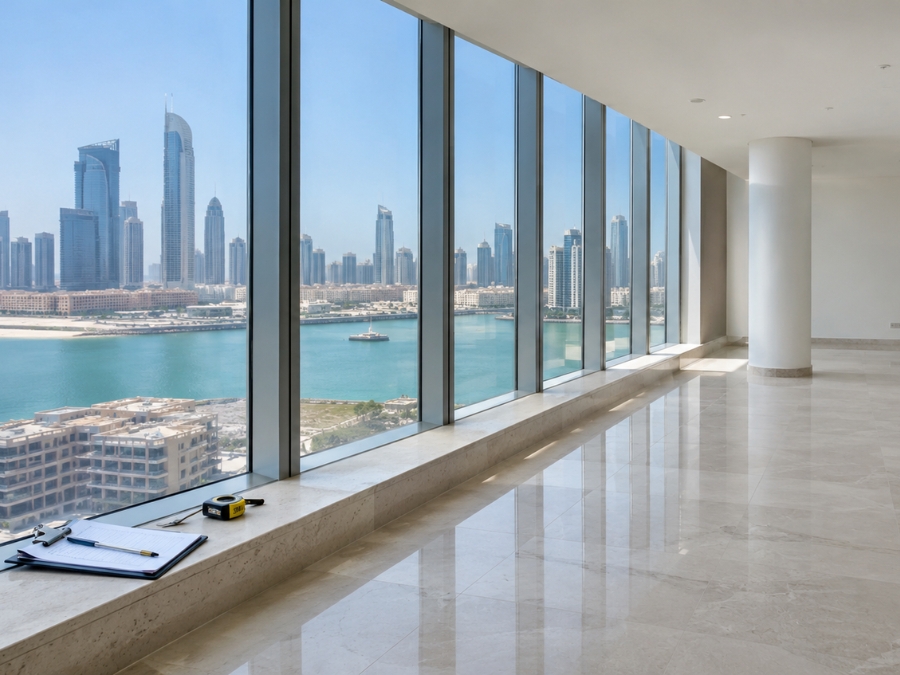
The Most Important Day in Your Property Journey
Receiving the keys to your Abu Dhabi property is not the end of the purchase process. It is the beginning of the most legally consequential day in the entire transaction. What you do in the hours between entering the unit and signing the handover acceptance form determines whether any defects, construction errors, or unfinished elements become the developer’s legal obligation to fix — or yours to live with. With thousands of off-plan handovers scheduled across Abu Dhabi in 2026 from communities including Nawayef Village, Yas Park Place, Al Naseem, and Nawayef Park Views, this guide addresses every stage of the process precisely and completely.
Read it before you go to handover. Not after.
Stage One: Before You Enter the Unit
The handover process begins before you set foot inside the property. Two steps happen first, and both matter.
Request a pre-handover notification in writing. Developers are legally required to notify you of the handover date in advance. Use that window to book a professional snagging company before the handover appointment. Do not rely on inspecting the property yourself unless you have construction or engineering experience. Professional inspectors use thermal imaging cameras, moisture meters, laser levels, and socket testers that identify defects invisible to the naked eye.
Confirm your payment position and title deed status. Ensure all scheduled payments have been registered through the DARI system, that your final payment has cleared, and that ADREC’s records reflect your ownership position correctly. Under Law No. 3 of 2015 as amended by Law No. 2 of 2025, developers must follow formal escalation procedures before taking any action related to payment — and your ownership rights are protected from the moment of registration. For buyers wanting guidance on navigating the legal and administrative dimensions of handover, speaking with an experienced real estate agency in Abu Dhabi that has overseen multiple handover processes is the most efficient preparation available.
Stage Two: The Snagging Inspection
A professional snagging inspection in Abu Dhabi typically takes two to four hours and covers every system and surface in the unit. Inspectors should hold InterNACHI accreditation or equivalent UAE certification. The inspection should generate a written report with photographs documenting every identified defect — this report becomes your legal evidence record if disputes arise.
The inspection should cover the following categories systematically:
| Category | What to Check |
| HVAC systems | Cooling performance, airflow balance across rooms, thermostat function, duct alignment, filter access |
| Plumbing | Run all taps for minimum five minutes, check for leaks under sinks, water pressure consistency, drainage speed in all wet areas |
| Electrical | Test every socket with a plug-in tester, check circuit breaker labelling in distribution board, test all light switches and fixtures |
| Waterproofing | Pour water on balcony floor and check drainage direction — pooling indicates a levelling error, check all bathroom joints and silicone seals |
| Walls and ceilings | Check for cracks, uneven plaster, paint inconsistencies, bubbling, mould behind wardrobes and under-sink cabinets |
| Doors and windows | Open and close every door and window — check alignment, seal quality, locking mechanism function, and any gaps around frames |
| Flooring | Check for hollow tiles by tapping across the entire floor surface, inspect grout lines, check for chips or lippage between tiles |
| Kitchen | Test all fitted appliances, check cabinet alignment and hinge function, inspect countertop joints, run dishwasher if installed |
| Finishes and fixtures | Check all sanitary ware for chips and cracks, mirror installation, towel rail and accessory fixings, wardrobe rail and shelf stability |
| Structural elements | Inspect all columns and beams for visible cracking, check ceiling junction lines for separation |
The most common defects identified in Abu Dhabi new-build properties are HVAC underperformance in extreme summer conditions, humidity-related mould hidden behind built-in panels or wardrobes, waterproofing failures in wet areas and balconies, hollow or cracked tiles, and poor finishing quality in paintwork and joinery.
Stage Three: Defect Categories and Developer Obligations
Not all defects carry the same legal weight. Understanding the categories helps you prioritise which items must be resolved before you sign and which can be addressed post-handover under the defect liability period.
| Defect Category | Definition | Action Required |
| Major structural defects | Foundation, load-bearing walls, structural columns | Do not sign handover — escalate to ADREC immediately |
| Critical system failures | Non-functioning HVAC, plumbing leaks, electrical faults | Request written confirmation of repair timeline before signing |
| Significant finishing defects | Waterproofing failures, cracked tiles, misaligned doors | Document in writing and include in handover report |
| Minor cosmetic defects | Paint inconsistencies, small scratches, grout gaps | Include in snagging report — developer must address within defect liability period |
| Fit-out incomplete | Missing fixtures, appliances not installed | Withhold keys acceptance until developer confirms completion date in writing |
Under Abu Dhabi law, developers carry a defect liability warranty obligation following handover. Structural defects that affect the building’s integrity or safety carry a ten-year warranty obligation under UAE Federal Civil Code Article 880. Finishing and non-structural defects are covered under a one-year defect liability period from the date of handover. Abu Dhabi’s Law No. 2 of 2025, which amended Law No. 3 of 2015, strengthened buyer protections further — introducing enhanced developer disclosure obligations and formal escalation procedures that must be followed before any developer action against a buyer can be taken.
Developers hold liability for materially inaccurate or incomplete pre-sale disclosures for two years from the date of transfer, per Administrative Decision No. 25 of 2025. If what was delivered does not match what was contracted and disclosed at the point of off-plan sale, that two-year window is your formal recourse period.
Stage Four: How ADREC Protects You
ADREC’s Dispute Settlement Centre is the formal channel for resolving any developer non-compliance with handover or defect repair obligations. The process is structured and does not require a lawyer at the initial stage — though legal representation becomes advisable if the dispute escalates to the Abu Dhabi Judicial Department.
The Madhmoun platform — ADREC’s property verification system — allows buyers to confirm the legal status of their property, verify that the developer has met their registered obligations, and access the official record of the unit’s contractual specifications against which any defect claim is assessed.
If a developer refuses to address defects identified in your snagging report, the correct escalation sequence is: formal written notice to the developer with a reasonable repair timeline, followed by a complaint submission to ADREC’s Dispute Settlement Centre if the developer does not respond or resolve within the stipulated period, followed by escalation to the Abu Dhabi Judicial Department for complex cases requiring court intervention. ADREC’s framework does not require buyers to negotiate informally — the formal channel exists precisely to give buyers institutional backing in disputes with developers. For buyers wanting to understand how to structure a defect complaint correctly, consulting a capital appreciation specialist in Abu Dhabi with direct ADREC dispute experience is the most efficient route to resolution.
What to Do at the Moment of Signing
If the snagging report identifies defects, you have three options at the moment of handover. First, you can refuse to sign the handover acceptance form until specific critical defects are resolved — this is your strongest legal position but may delay your move-in. Second, you can sign with an attached snagging report that is formally acknowledged by the developer in writing, creating a documented obligation to remedy the listed defects within an agreed timeline. Third, for minor cosmetic defects only, you can sign and rely on the defect liability period for remedy — but this option should only be used for items that carry no structural or functional risk.
Never sign the handover acceptance form without either a clear property or a formal written defect acknowledgment attached. Once you sign without qualification, your legal leverage for outstanding defects weakens materially. The handover certificate is not a formality. It is a legal instrument — treat it as one.
Conclusion
Abu Dhabi’s 2026 handover wave — spanning Hudayriyat Island, Yas Island, Saadiyat Island, and multiple Aldar and Modon communities — will put thousands of buyers through this process in the coming months. The buyers who arrive prepared — with a professional snagging inspector booked, a clear understanding of defect categories and warranty periods, and knowledge of ADREC’s formal dispute process — will protect their investment from day one. The buyers who sign without preparation will spend months pursuing remedies they could have secured at the handover table in an afternoon.
Book a professional snagging inspector as soon as you receive formal notification of your handover date — ideally to conduct the inspection before you attend the official handover appointment. Do not sign the handover acceptance form until the inspection is complete and any critical defects are formally documented. For handover support across Abu Dhabi’s most active communities, speak with a trusted real estate brokerage in Abu Dhabi.
Finishing and non-structural defects are covered under a one-year defect liability period from the date of handover. Structural defects affecting the building’s integrity or safety carry a ten-year warranty obligation under UAE Federal Civil Code Article 880. Under Law No. 2 of 2025, developers are also liable for materially inaccurate pre-sale disclosures for two years from the date of transfer.
The most frequently identified defects are HVAC underperformance in summer conditions, humidity-related mould behind built-in panels and wardrobes, waterproofing failures in bathrooms and balconies, hollow or cracked tiles, and poor finishing quality in paintwork and joinery. A professional inspection covering all these areas typically takes two to four hours.
Submit a formal written notice to the developer with a reasonable repair timeline. If unresolved, file a complaint with ADREC’s Dispute Settlement Centre. If the dispute cannot be resolved at that level, ADREC has escalation routes to the Abu Dhabi Judicial Department. Do not rely solely on informal negotiation — ADREC’s formal channel gives you institutional backing. Get guidance from an Abu Dhabi real estate investment advisor on structuring your complaint correctly.
For minor cosmetic defects only, you may sign with the snagging report formally attached and acknowledged in writing by the developer, creating a documented repair obligation. For structural defects, critical system failures, or incomplete fit-out, do not sign until the issue is resolved or a formal written commitment with a specific timeline is obtained. Find expert pre-handover guidance through a professional property advisory firm in Abu Dhabi.
Join The Discussion