
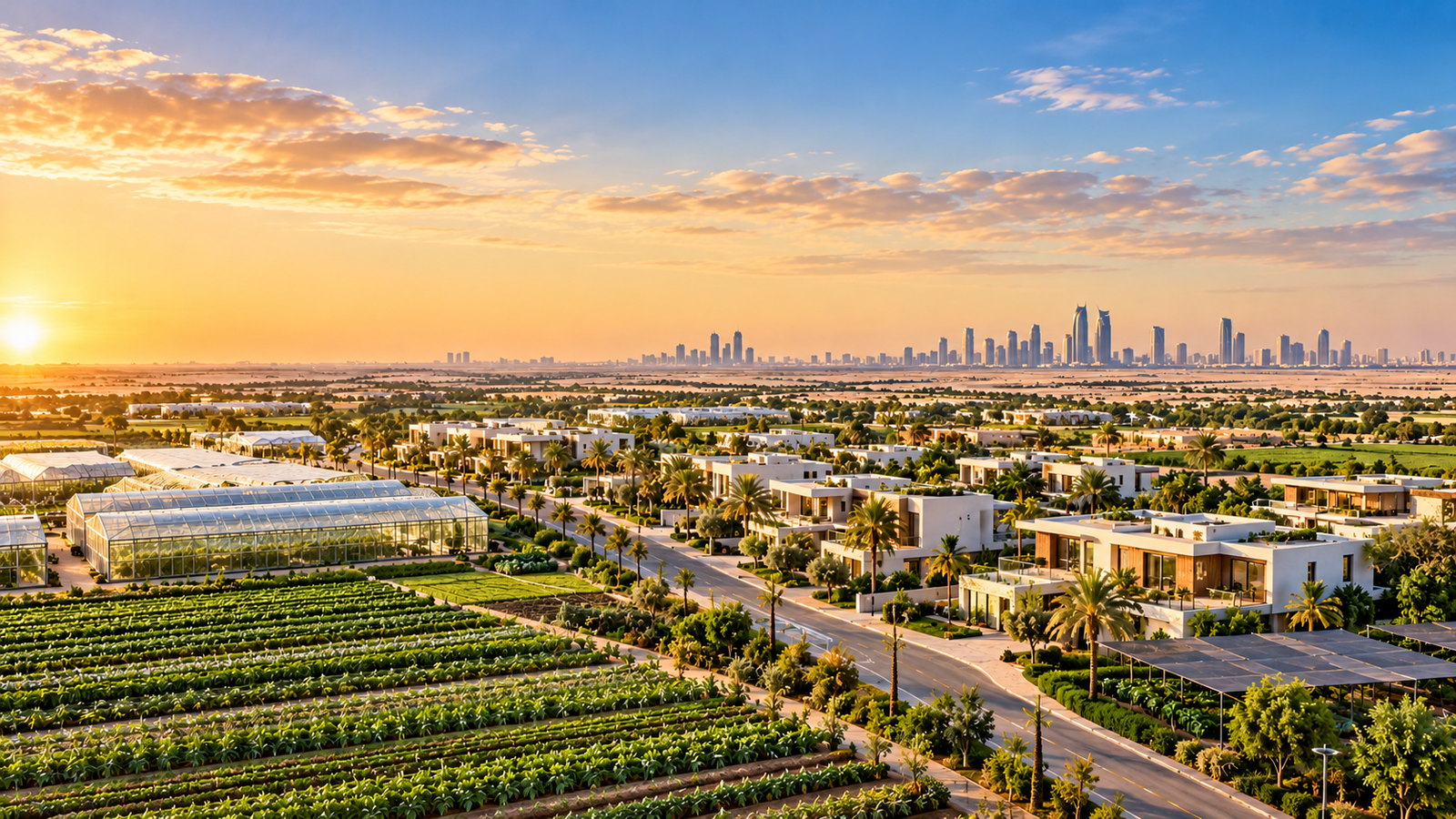
Abu Dhabi is preparing for a new type of community development that brings housing, agriculture, technology and food production together within one large-scale destination.
Qitaf City, an agricultural community being developed in Abu Dhabi, is planned across approximately four million square metres and is intended to support the UAE’s long-term food-security and self-sufficiency ambitions.
Rather than functioning solely as an agricultural zone, the development is expected to combine villas, townhouses and Emirati housing with farms and AgriTech initiatives.
The concept adds another dimension to Abu Dhabi’s evolution: communities designed not only around places to live, but also around strategic national priorities such as food resilience, sustainability, technology and logistics.
What is Qitaf City in Abu Dhabi?
Qitaf City is a planned agricultural community in the Al Haffar area of Abu Dhabi.
According to information shared by Qitaf Holding leadership, the development will cover around four million square metres and combine residential communities with agricultural uses and technology-driven farming projects.
Its planned components include:
- Villas
- Townhouses
- Emirati housing
- Agricultural farms
- AgriTech projects
- Aquaculture-related activities
- Research and agricultural experimentation
The objective is to create an ecosystem where people can live closer to food production while new agricultural technologies are tested and developed.
The initiative is being advanced by Qitaf Holding, which was established as the agricultural arm of Abu Dhabi National Investment and Development.
Why is Abu Dhabi developing an agricultural city?
Food security has become increasingly important globally, particularly as geopolitical events and disruptions to international supply routes demonstrate how dependent countries can be on complex international food-supply networks.
For the UAE, strengthening domestic production, developing agricultural technology and creating more resilient supply chains are therefore strategic priorities.
Qitaf City is designed to contribute to that objective.
The development is expected to create an environment where farming, technology, education and food production can operate together rather than as isolated activities.
It also comes as Abu Dhabi continues to advance its wider Agricultural Transformation Strategy and strengthen innovation across the emirate’s agriculture and food sectors.
Technology will play an important role
One of the most interesting aspects of Qitaf City is that the project is not based on traditional farming alone.
Agricultural technology is expected to have a major role.
One of the first projects reported for the city involves testing potato cultivation together with solar-panel applications as part of an agricultural laboratory process.
The community is also expected to explore areas such as aquaculture and other forms of technology-enabled agriculture.
This approach is particularly relevant in the UAE, where agriculture must respond to factors including an arid climate, water efficiency and the need to produce food sustainably.
Developing agricultural technology alongside residential and educational uses could therefore make Qitaf City an important testing ground for future farming models.
A strategically connected location
Location is another important part of the Qitaf City concept.
The development is planned in Al Haffar and has been described as approximately 40 minutes from Abu Dhabi city, Al Ain and Dubai’s Al Maktoum International Airport.
More importantly for an agricultural hub, the Etihad Rail corridor runs alongside the area.
Future freight connectivity could make it easier to transport agricultural produce from the community to processing facilities, distribution centres and other destinations across the UAE.
For a food-production ecosystem, this logistics connection could be as important as the farms themselves.
More than an agricultural project
Qitaf City is expected to form part of a broader master plan rather than operate as an isolated farming development.
Plans discussed for the wider destination include residential estates as well as sports and medical components.
This reflects an increasingly common direction in Abu Dhabi’s urban planning: creating integrated destinations where residential, economic, recreational and specialised uses support one another.
For people following the expansion of Abu Dhabi beyond its established residential districts, projects of this scale are worth watching because infrastructure and new economic activities can gradually influence where future communities emerge.
Buyers researching established and upcoming communities can explore current properties for sale in Abu Dhabi through NAS Luxury Real Estate.
What could Qitaf City mean for Abu Dhabi real estate?
Qitaf City should first be understood as an agriculture and food-security initiative rather than being treated simply as another residential property launch.
However, its residential component makes it relevant to Abu Dhabi’s wider real-estate story.
Major master-planned developments can create new residential nodes when they are supported by employment, infrastructure, transport and community facilities.
Qitaf City potentially brings several of these elements together:
Agricultural employment and research could generate economic activity.
Housing would introduce a permanent residential population.
Etihad Rail proximity could strengthen logistics connectivity.
Agricultural technology could attract businesses, researchers and specialist organisations.
Sports, medical and other elements proposed for the wider master plan could further diversify the destination.
That does not automatically translate into property-price appreciation, and there is currently insufficient publicly reported information to make such a prediction.
What it does demonstrate is that Abu Dhabi continues to expand through specialised master-planned communities connected to wider economic objectives.
Investors looking at currently available new developments elsewhere in the emirate can explore off-plan properties in Abu Dhabi.
Abu Dhabi’s communities are becoming increasingly specialised
For many years, location and residential quality were the primary factors separating one property development from another.
That is changing.
Across Abu Dhabi, newer destinations are increasingly linked to specific lifestyle or economic themes: culture, waterfront living, entertainment, sustainability, health, technology and now agriculture.
Qitaf City represents another version of this evolution.
Its central proposition is not simply housing beside landscaping. Agriculture itself is expected to form part of the community ecosystem.
That distinction could make the project particularly relevant to people interested in agricultural entrepreneurship, research, sustainable food production and new models of community living.
Connecting residents with agriculture
Another objective behind Qitaf City is to reconnect people with food production.
The project is expected to encourage university students and people interested in agriculture to participate in farming and potentially supply their produce to the market.
This could give the community an educational role alongside its commercial and residential functions.
Agriculture, aquaculture and AgriTech operating within the same ecosystem could also help create greater awareness of how food is produced and how technology can improve production efficiency.
An international food ecosystem
Qitaf Holding’s ambitions also extend beyond domestic agriculture.
The company is working on agricultural initiatives in Africa and Asia and announced a green corridor between Tanzania and the UAE during Global Food Week.
The wider concept involves connecting overseas farmers with the UAE for processing, manufacturing and potentially re-exporting agricultural products.
If such networks develop as planned, Abu Dhabi’s role could extend beyond producing more food locally to becoming a larger agricultural processing, technology and distribution hub.
When will Qitaf City launch?
The October 2026 report states that the agricultural city project is slated to launch in February.
Given the timing of the announcement, this indicates February 2027.
Further details on development phases, residential inventory, ownership eligibility, pricing and individual property launches had not been disclosed in the information reviewed at the time of writing.
Prospective buyers should therefore avoid treating early reports as a confirmed property sales launch.
NAS Luxury Real Estate will continue following new communities, infrastructure projects and property developments shaping the Abu Dhabi market. Buyers and investors can explore Abu Dhabi real estate opportunities based on their objectives, preferred communities and investment horizon.
Why Qitaf City matters
Qitaf City represents something larger than a new farming area.
It brings together food security, agricultural technology, housing, logistics and community development within one master-planned concept.
For the UAE, it could support efforts to build a more resilient food ecosystem.
For Abu Dhabi, it demonstrates how future urban expansion can be connected directly to strategic economic priorities.
And for the real-estate market, it provides another example of why understanding infrastructure, economic activity and long-term master planning is increasingly important when assessing where Abu Dhabi is heading next.
Qitaf City is a planned four-million-square-metre agricultural community in Abu Dhabi’s Al Haffar area. It is expected to combine residential housing, farms, agricultural technology projects and other food-production activities as part of efforts to strengthen UAE food security.
Yes. Current plans reported for the development include villas, townhouses and Emirati housing alongside agricultural areas and AgriTech projects. However, public information reviewed so far does not provide residential prices, unit numbers, ownership conditions or confirmed property sales dates.
Qitaf City is planned in Al Haffar, with its location described as approximately 40 minutes from Abu Dhabi city, Al Ain and Al Maktoum International Airport. Etihad Rail also runs alongside the area, which could support future agricultural logistics.
A public residential sales launch, property prices and ownership terms were not included in the information available at the time of writing. Buyers looking for currently available opportunities can instead review verified off-plan properties in Abu Dhabi and seek professional guidance before making a purchase decision.
Large master-planned projects can help investors understand how Abu Dhabi’s population centres, infrastructure and economic activity may evolve over time. However, each project should be assessed individually rather than assuming future appreciation. Investors who want a personalised view of Abu Dhabi’s luxury and emerging markets can also consult Ayman Sadieh for property advisory insight.
Join The Discussion