
Introduction
Abu Dhabi’s commitment to Emirati homeownership is not measured in intention — it is measured in disbursements, fulfillment rates, and billion-dirham infrastructure agreements. In Q1 2026, the Sheikh Zayed Housing Programme issued 759 housing approvals totalling AED 616 million — the latest quarterly delivery in a programme that has operated continuously since 1999 and now sits at the centre of the most ambitious residential expansion in the emirate’s history. With a 91% Emirati homeownership rate achieved and a AED 106 billion community development pipeline underway, Abu Dhabi’s housing framework is executing at a scale that few comparable programmes globally can match.
Q1 2026 Approval Breakdown
The Ministry of Energy and Infrastructure, through the Sheikh Zayed Housing Programme, issued three categories of housing support in Q1 2026:
| Approval Type | Number of Approvals | Total Value |
| Housing grants and benefits | 129 | AED 102.9 million |
| Housing loans via national banks | 583 | AED 460.5 million |
| Government housing loans (residential complexes) | 47 | AED 53.2 million |
| Total | 759 | AED 616 million |
The loan and financing tier — 583 approvals worth AED 460.5 million — constitutes 76.8% of all Q1 approvals by volume and 74.7% by value, reflecting the programme’s growing reliance on a public-private partnership model that channels financing through national banks rather than purely through direct government disbursement. This shift has been central to the programme’s operational transformation over the past decade.
Programme Performance Since 1999
The Sheikh Zayed Housing Programme was established in 1999 under the Ministry of Energy and Infrastructure. Its cumulative performance over 27 years places it among the most impactful national housing initiatives in the region:
| Metric | Figure |
| Total housing support decisions issued | 73,000+ |
| Total cumulative value | AED 50 billion+ |
| Backlog applications eliminated | 12,000+ |
| Fulfillment rate — before PPP model | 34% |
| Fulfillment rate — current | 94% |
| Emirati homeownership rate achieved | 91% |
The improvement in fulfillment rate from 34% to 94% is the most telling performance indicator. It reflects a structural overhaul of service delivery — from a predominantly public, centralised model to an integrated public-private partnership framework that dramatically accelerated processing capacity and reduced approval timelines. The elimination of over 12,000 backlog applications represents not just administrative efficiency but a direct improvement in the quality of life of thousands of Emirati families. For investors and buyers seeking to understand Abu Dhabi’s broader residential supply pipeline, NAS Luxury Real Estate provides expert guidance on how government-driven development programmes interact with the open market.
The AED 106 Billion Community Development Pipeline
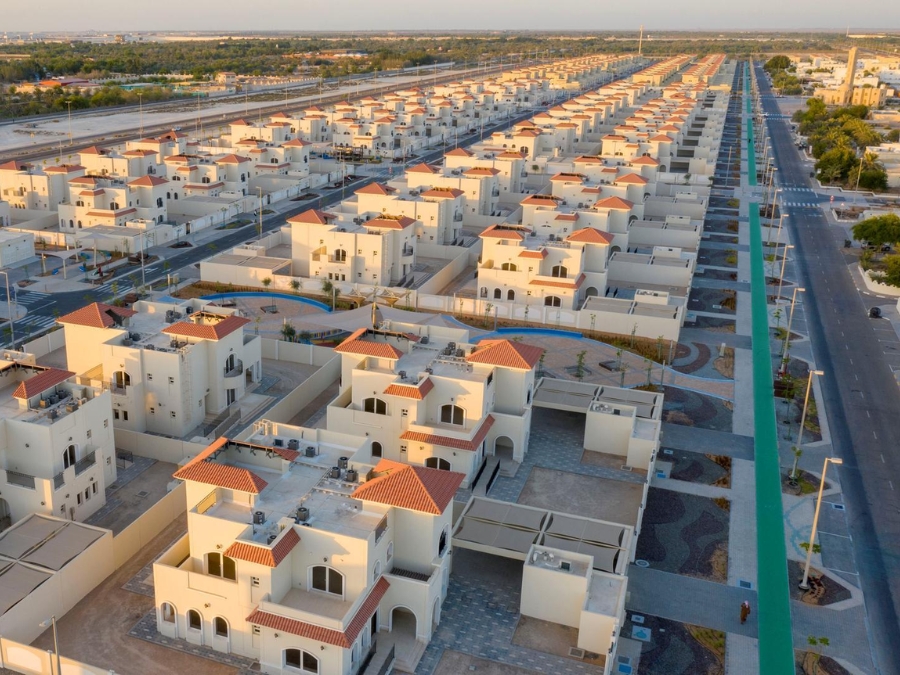
The Q1 2026 approvals sit within a vastly larger strategic context. In September 2025, UAE President Sheikh Mohamed bin Zayed Al Nahyan attended the announcement of agreements to develop 13 new residential communities across Abu Dhabi, Al Ain, and the Al Dhafra Region — comprising more than 40,000 homes and residential plots at a total cost of AED 106 billion:
| Location | Communities | Units | Cost |
| Abu Dhabi City | 6 communities | 14,444 units | AED 55.38 billion |
| Al Ain | 5 communities | 10,480 units | AED 36.95 billion |
| Al Dhafra Region | 2 communities | 320 units | AED 1.59 billion |
| Total (new projects) | 13 communities | 25,244 units | AED 94 billion |
| Residential plots (additional) | — | 14,876 plots | AED 12 billion |
| Grand total | — | 40,120+ units & plots | AED 106 billion |
Developers signed to deliver these communities include Aldar Properties, Bloom Holding, Modon Properties, Wahat Al Zaweya Real Estate, and IMKAN Properties. All projects are scheduled for completion by 2029, bringing the Abu Dhabi Housing Authority’s total portfolio of homes and plots under active development to approximately 45,000 units.
Broader Investment Context: AED 148 Billion in Committed Spending
The housing programme operates within a significantly larger government investment framework that the UAE has committed to residential and liveability infrastructure:
| Initiative | Value | Timeline |
| 13 new Emirati communities | AED 106 billion | By 2029 |
| Liveability and quality of life projects | AED 42 billion | Announced Sep 2025 |
| UAE federal budget (housing & infrastructure share) | Part of AED 900 billion | 2027–29 budget cycle |
The AED 42 billion liveability investment — announced simultaneously with the housing communities in September 2025 — targets schools, parks, healthcare facilities, commercial centres, and transport infrastructure within and adjacent to the new residential developments. This integrated approach transforms the 13 new communities from housing projects into fully self-sufficient urban districts — a model that mirrors the master-planned philosophy already demonstrated on Hudayriyat Island and Yas Island.
What This Means for Abu Dhabi’s Property Market
Government-backed Emirati housing programmes do not operate in isolation from the wider real estate market. Their scale and funding create measurable downstream effects:
- Construction demand: AED 94 billion in housing construction contracts across five developers accelerates activity in materials, labour, and contracting sectors
- Infrastructure spillover: AED 42 billion in liveability investment raises the quality and connectivity of surrounding areas, supporting value growth in adjacent open-market developments
- Supply discipline: Emirati housing is ring-fenced from the open market, meaning the 40,000+ units entering development by 2029 do not directly compete with investor-grade off-plan supply — preserving demand dynamics in the freehold sector
- Market confidence signal: The scale of government commitment validates Abu Dhabi’s residential expansion trajectory for the 2026–2029 period, reinforcing investor confidence across both government and private housing segments
Conclusion
The Sheikh Zayed Housing Programme’s Q1 2026 figures — 759 approvals, AED 616 million disbursed, a 94% fulfillment rate — represent the quarterly operational cadence of a programme that has fundamentally reshaped Emirati homeownership since 1999. Set against the AED 106 billion community development pipeline announced in September 2025 and the broader AED 148 billion committed government investment framework, these quarterly outputs are the mechanism through which Abu Dhabi’s most ambitious residential vision is being translated, one family at a time, into reality.
759 approvals worth a total of AED 616 million — comprising 129 grants (AED 102.9 million), 583 bank-partnered loans (AED 460.5 million), and 47 government housing loans in residential complexes (AED 53.2 million). Explore Abu Dhabi’s property landscape at NAS Luxury Real Estate.
Since its establishment, the programme has issued over 73,000 housing support decisions valued at more than AED 50 billion, raised its fulfillment rate from 34% to 94%, eliminated over 12,000 backlog applications, and supported a 91% Emirati homeownership rate.
Announced in September 2025, it covers 13 new Emirati residential communities across Abu Dhabi City, Al Ain, and Al Dhafra — delivering 25,244 housing units and 14,876 residential plots at a total cost of AED 106 billion, all scheduled for completion by 2029. For expert real estate guidance aligned with Abu Dhabi’s development pipeline, consult a trusted property advisor .
Aldar Properties, Bloom Holding, Modon Properties, Wahat Al Zaweya Real Estate, and IMKAN Properties are the five developers contracted to deliver the 13 new communities across Abu Dhabi City, Al Ain, and Al Dhafra Region by 2029.
The 40,000+ Emirati units are ring-fenced from the freehold market, meaning they do not directly compete with investor-grade supply — preserving demand dynamics in off-plan and ready sectors. Get strategic investment advice at NAS Luxury Real Estate.
Join The Discussion