
The Summit That Put the Number in Writing
On June 23 and 24, 2026, Abu Dhabi hosted the second edition of the Forbes Middle East Building the Future Summit at an event bringing together approximately 3,000 policymakers, business executives, and industry experts under the patronage of the UAE Ministry of Energy and Infrastructure. The summit was organised by Forbes Middle East in partnership with One Development and focused on the intersection of infrastructure, smart cities, clean energy, mobility, and artificial intelligence.
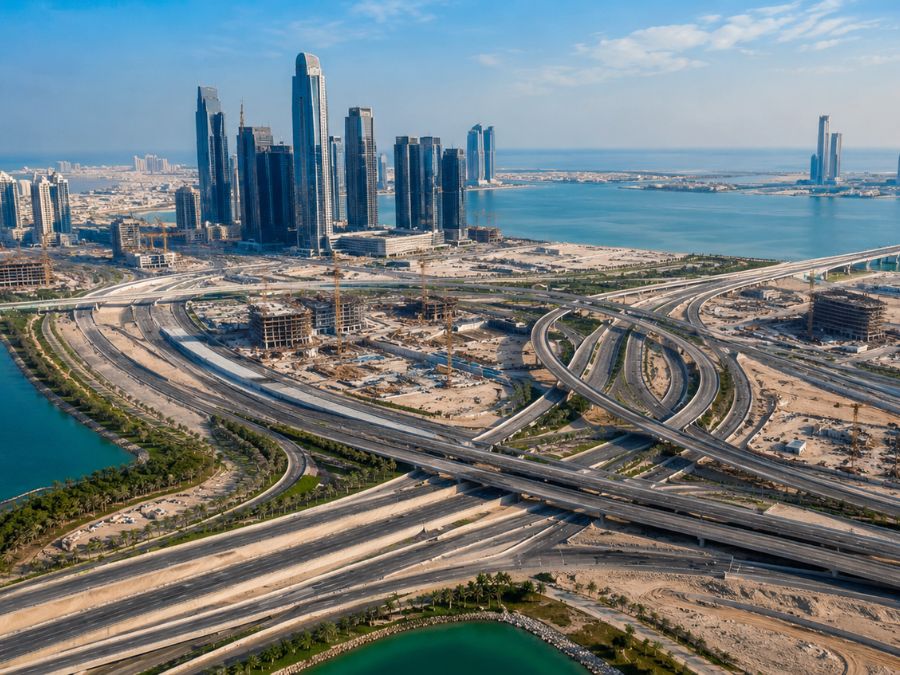
What the summit made official — and what every property investor in Abu Dhabi should understand clearly — is the scale of the infrastructure programme currently being executed around, beneath, and between the communities where people live and buy. The Abu Dhabi Projects and Infrastructure Centre is overseeing a capital investment portfolio worth more than AED 200 billion comprising over 600 ongoing projects spanning housing, transportation, healthcare, education, tourism, and community infrastructure. This is not a future commitment. It is a live, active programme being managed and delivered right now across Abu Dhabi, Al Ain, and the Al Dhafra Region.
The Full Programme: What AED 200 Billion Actually Covers
Understanding the investment implications requires understanding precisely what the AED 200 billion portfolio contains. It spans six sectors and represents one of the largest infrastructure capital expenditure programmes in the Gulf region.
| Sector | Coverage |
| Housing | New integrated residential communities across Abu Dhabi, Al Ain, and Al Dhafra |
| Transportation | Road networks, bridges, tunnels, major intersections, connectivity between emerging areas |
| Healthcare | Advanced hospitals, specialist medical facilities, community health infrastructure |
| Education | Schools, universities, and learning facilities for anticipated population growth |
| Tourism | Cultural attractions, public amenities, and visitor infrastructure |
| Community services | Parks, mosques, sports facilities, retail, and public utilities |
This portfolio represents one of the largest infrastructure capital expenditure programmes in the region, per ADPIC’s official disclosure at the summit. Within that programme, the AED 55 billion PPP pipeline announced at ADIS 2026 in May — covering 24 new projects for 2026 and 2027 — sits as the newest and most actively structured layer, bringing private capital alongside government funding to accelerate delivery timelines and execution quality across all six sectors simultaneously.
What This Means for Abu Dhabi’s Property Market
Infrastructure of this scale does not operate as a parallel story to the real estate market. It is the foundation of it. Every AED spent on roads, bridges, schools, hospitals, and community amenities creates and preserves the residential demand that underpins property values across the emirate.
The property market case for infrastructure investment is not theoretical. It is consistently demonstrated by data. Communities positioned adjacent to new road and bridge infrastructure record measurable appreciation as commute times shorten and accessibility improves. Communities anchored by established schools and hospitals attract the stable, long-term tenant base — teachers, healthcare workers, government employees — that generates the most resilient rental yields. Communities built within a master-planned urban framework governed by a unified infrastructure authority deliver the consistent service quality that sustains resident satisfaction and community Net Promoter Scores over time.
Abu Dhabi’s official data and recent economic reports confirm the emirate has moved beyond the phase of building essential infrastructure and entered a new era focused on developing smart, sustainable infrastructure capable of supporting the future economy. That transition from essential to smart infrastructure is the most significant long-term quality signal available for any Abu Dhabi property acquisition — because it means the communities delivering in 2026, 2027, 2028, and 2029 will be embedded in an infrastructure ecosystem more advanced than anything that preceded them.
The AED 35 billion transport and road component of the AED 55 billion PPP pipeline — covering 300 kilometres of new and upgraded roads, bridges, tunnels, and major intersections — directly affects the connectivity premium of specific communities. New bridge links connecting Hudayriyat Island, Al Nouf, and Abu Al Abyad Island were among the confirmed projects announced at ADIS 2026. The Phase 2 tender for the bridge connecting Khalifa City to Saadiyat Island via Umm Yifeenah is also set for release. For investors who understand that infrastructure precedes appreciation, the specific corridors and islands named within the AED 35 billion transport allocation are the most direct forward-looking map of where residential values are heading next. For buyers wanting to identify which communities within those corridors represent the strongest current entry points, working with a professional real estate advisory firm in Abu Dhabi that tracks infrastructure delivery timelines alongside transaction data is the most direct route to an informed decision.
The AED 11 Billion Water and Climate Resilience Component
One component of the AED 55 billion PPP pipeline that receives less attention in property market conversations than it deserves is the AED 11 billion allocated to water and flood protection — covering five projects developing dams, water storage facilities, stormwater drainage systems, and flood protection infrastructure.
For property investors, infrastructure resilience against climate events is increasingly a material factor in asset quality assessment. The severe adverse weather that affected the UAE in 2024 and the adverse weather periods in Q1 2026 demonstrated that climate resilience infrastructure is not a planning aspiration — it is an operational necessity. Communities positioned within areas where AED 11 billion in water management and flood protection infrastructure is being actively installed carry a meaningfully lower long-term climate risk profile than those where that infrastructure does not yet exist. As global institutional investment increasingly incorporates climate risk screening into real estate portfolio assessment, that distinction will become a quantifiable premium in Abu Dhabi’s most protected communities.
The Smart and Sustainable Dimension
Beyond the capital expenditure, the Forbes Summit highlighted Abu Dhabi’s commitment to a comprehensive ecosystem powered by artificial intelligence, digital governance, and smart technologies. The unified infrastructure governance framework involving 14 government entities — introduced to accelerate approvals, reduce project delivery timelines, and improve coordination — is the operational mechanism that converts the AED 200 billion commitment from an ambition into a delivery programme.
Sharif Al Olama, Undersecretary for Energy and Petroleum Affairs at the Ministry of Energy and Infrastructure, confirmed at the summit: “The future of energy and infrastructure will be shaped by the integration of sustainability, innovation, and advanced technologies. The UAE continues to adopt a forward-looking approach that combines clean energy, digital transformation, and resilient infrastructure to support economic growth and enhance quality of life.”
For investors, AI-driven urban services and intelligent transportation systems within Abu Dhabi’s communities are not features that command a premium today — but they are features that will command a premium within a five to ten-year investment horizon as smart city infrastructure becomes a baseline expectation rather than a differentiator. Communities built to this standard now will carry that quality advantage for decades. Getting guidance on which of Abu Dhabi’s current and forthcoming communities are being built to this standard from a trusted VIP property broker in Abu Dhabi who understands the infrastructure pipeline as well as the market is how sophisticated investors convert this macro intelligence into specific acquisition decisions.
The Broader Confidence Signal
Ali Al Jebely, Founder and Chairman of One Development and summit co-organiser, described the event’s purpose directly: “Amid evolving market dynamics, the Forbes Middle East Building the Future Summit serves as an important platform to highlight the UAE real estate sector, its resilience, innovation, and global appeal.”
That positioning — a global summit hosted in Abu Dhabi, attended by 3,000 leaders from across the infrastructure and investment universe, focused explicitly on the future of cities and real estate — is itself a demand driver. Events of this profile generate media coverage, investor attention, and institutional capital flows into the markets they spotlight. The inaugural edition of the Forbes Middle East Building the Future Summit attracted more than 4,100 participants from over 100 countries. The 2026 edition arrives with approximately 3,000 confirmed participants and with ADPIC’s AED 200 billion programme as its centrepiece.
Abu Dhabi is not hosting this summit to tell investors that it has an infrastructure programme. It is hosting it to show them — in the most credible format available — that the infrastructure underpinning its real estate market is the deepest, most systematically managed, and most forward-looking of any city in the region.
Conclusion
AED 200 billion. 600 ongoing projects. AED 55 billion in new PPP infrastructure launching in 2026 and 2027. A unified governance framework across 14 government entities. A global summit confirming the scale and direction of Abu Dhabi’s urban ambition on an international stage. For property investors evaluating Abu Dhabi in the second half of 2026, the Forbes Middle East Building the Future Summit is not a corporate event worth noting. It is a data event worth acting on — because every project within the AED 200 billion portfolio is a demand driver for the residential communities being built, bought, and held within its reach.
The second edition of the Forbes Middle East Building the Future Summit took place in Abu Dhabi on June 23 and 24, 2026, bringing together approximately 3,000 policymakers, business executives, and industry experts to discuss sustainable urban development, smart infrastructure, clean energy, and AI-driven city planning across the Middle East. Explore Abu Dhabi’s most infrastructure-backed residential communities through a licensed property brokerage in Abu Dhabi.
ADPIC’s active portfolio covers more than 600 ongoing projects across housing, transportation, healthcare, education, tourism, and community services — including new residential communities, road networks, bridges, tunnels, hospitals, schools, cultural facilities, and public utilities across Abu Dhabi, Al Ain, and Al Dhafra Region. It represents one of the largest infrastructure capital expenditure programmes in the Gulf region.
The AED 55 billion PPP programme covers 24 new projects: AED 35 billion for 11 transport and road projects including 300 kilometres of new and upgraded infrastructure, AED 11 billion for five water and flood protection projects, and AED 9 billion for social infrastructure including schools, hospitals, and community facilities — all structured through public-private partnerships and scheduled for delivery in 2026 and 2027. For investment guidance on communities within the infrastructure delivery corridors, consult an Abu Dhabi real estate investment advisor.
Infrastructure investment directly creates and sustains residential demand by improving connectivity, anchoring stable institutional tenant populations through schools and hospitals, and embedding community quality standards into the built environment. Communities positioned within active infrastructure delivery zones consistently record measurable appreciation as projects complete — and the AED 200 billion programme represents the most comprehensive infrastructure quality signal available for any Abu Dhabi property market analysis.
ADPIC’s unified infrastructure governance framework brings 14 government entities including municipalities, energy and water authorities, telecommunications, and Etihad Rail under a single coordination mechanism, designed to accelerate NOC issuance, reduce project delivery timelines, and improve cross-stakeholder coordination. The framework lowers operating costs, improves government spending efficiency, and accelerates the delivery of the strategic projects that directly support residential community quality across Abu Dhabi. Explore how this affects specific communities with a top-rated real estate agency in Abu Dhabi.
Join The Discussion