
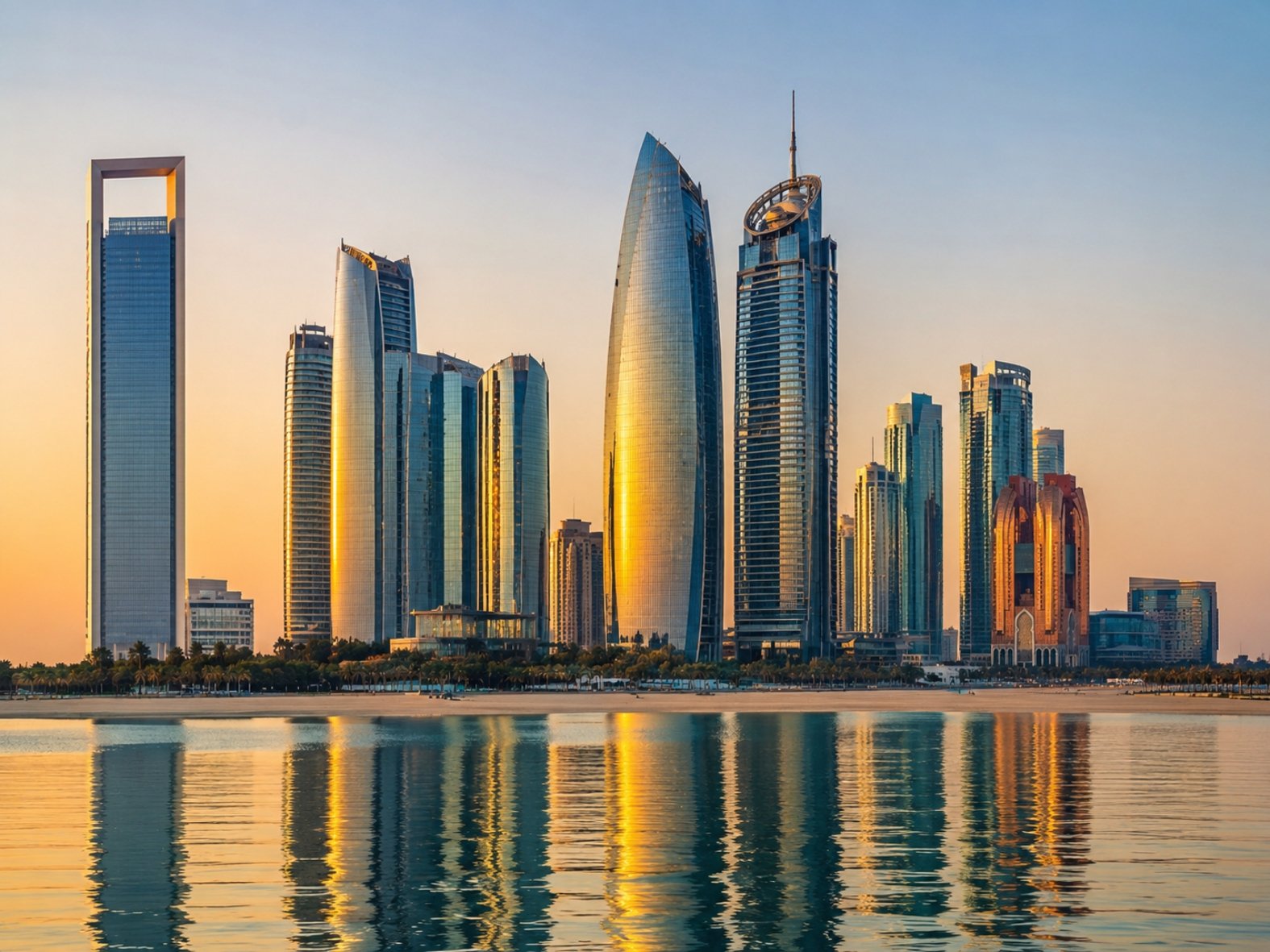
Some of the most convincing evidence of a market’s underlying strength comes not from its best quarters, but from how it performs when conditions get genuinely difficult. Abu Dhabi’s first half of 2026 unfolded against a backdrop of real global uncertainty — and international investors responded not by pulling back, but by nearly doubling their exposure to the emirate’s property market. Foreign direct investment into Abu Dhabi real estate reached AED 13.8 billion in the first six months of 2026, a 309% increase year-on-year, already exceeding the total foreign investment recorded across the entirety of 2025.
That figure did not happen quietly. Total property transactions across the emirate rose 112% year-on-year to AED 117 billion, supported by a 61.7% jump in the number of deals. For a market operating through what has genuinely been a difficult and uncertain period globally, that combination of resilience and acceleration is not something markets typically produce by accident.
The Full Picture: What ADREC’s H1 2026 Data Confirms
The Abu Dhabi Real Estate Centre’s official first-half figures paint a comprehensive picture of a market strengthening across every measurable dimension:
| Metric | H1 2026 | YoY Change |
| Total transaction value | AED 117 billion | +112% |
| Total transaction volume | — | +61.7% |
| Foreign direct investment | AED 13.8 billion | +309% |
| Nationalities investing | 116 (up from 82) | +34 nationalities |
| Investment zone activity | AED 75 billion | +181% |
| New investment zones approved | 8 (total now 50) | — |
| New real estate projects registered | 28 | +16% |
The 34-nationality increase in foreign investor participation is arguably the most telling figure in the entire dataset. It is not simply that existing investors deployed more capital — an entirely new cohort of international buyers, from markets that were not previously significant sources of Abu Dhabi investment, entered the market during precisely the window when global headlines were dominated by difficult and uncertain news.
Where the Capital Is Coming From
The United Kingdom, China, Russia, the United States, Germany, and France ranked among the leading sources of foreign direct investment in Abu Dhabi’s H1 2026 property market. That spread across Western Europe, North America, and Asia confirms something important: this was not capital flight from a single region seeking a safe haven. It was a genuinely diversified, global reassessment of Abu Dhabi as a long-term destination for real estate capital, with buyers from some of the world’s largest and most sophisticated economies increasing their commitment simultaneously.
Abu Dhabi’s investment zones — open to ownership by investors of all nationalities — attracted AED 75 billion during H1 2026, up 181% from AED 26.7 billion in the same period last year. For investors evaluating Abu Dhabi’s investment zones as a destination for capital during a period when many global markets are characterised by caution rather than conviction, that 181% growth figure is a direct answer to the question of where confidence is actually flowing right now.
Why Investors Kept Buying Through a Difficult Period
It would be reasonable to assume that difficult and uncertain global conditions would suppress cross-border property investment, at least temporarily. Abu Dhabi’s H1 2026 data shows the opposite happened, and the reasons are structural rather than coincidental.
Rashed Al Omaira, Director-General of ADREC, offered the clearest explanation available: “Investment decisions begin long before any transaction is completed. They start with a clear understanding of the market, its trends and the regulatory frameworks governing it… our focus at the Abu Dhabi Real Estate Centre is on providing investors with the highest level of clarity and credibility from the outset through a transparent regulatory framework and reliable, continuously updated market data.”
That framing matters. Investors making six and seven-figure commitments during genuinely difficult regional and global times are not doing so on sentiment. They are doing so because Abu Dhabi’s regulatory transparency, sovereign wealth backing, and consistent long-term development trajectory gave them enough confidence to look past short-term headlines. The addition of eight new investment zones and 28 newly registered real estate projects during this same window confirms that developers shared that same confidence — expanding supply at precisely the moment a more cautious market would have paused it.
A Note of Honest Balance
Not every part of the broader picture was uniformly positive, and a genuinely useful market update should say so plainly. Independent economic analysis has noted that overall real estate activity softened somewhat in the first half of 2026 after several years of exceptionally strong growth, with the effect varying meaningfully between different segments and locations, even as prices broadly held at or above the prior year’s levels. Rising material costs, contractor shortages, and higher land prices have also placed some pressure on developer margins across the UAE more broadly during this period.
None of that changes the headline story for Abu Dhabi specifically — a 112% rise in transaction value and a 309% surge in foreign investment are not the numbers of a market under strain. But it does mean the picture is one of a fundamentally strong market navigating real cost and margin pressures sensibly, rather than one immune to any friction at all. For investors, that is arguably the more reassuring version of events: growth that is being achieved without denial of the genuine challenges around it. For guidance on navigating both the opportunities and the cost realities currently shaping the market, working with a capital appreciation specialist in Abu Dhabi who tracks both sides of this picture is the most balanced way to plan an entry.
Conclusion
Abu Dhabi’s H1 2026 performance tells a story that goes beyond a single record-breaking headline. It is the story of a market that, during a genuinely difficult period for the wider region and global economy, saw international investors from 116 nationalities not retreat but nearly double their commitment. AED 13.8 billion in foreign direct investment, already ahead of all of 2025. Thirty-four new investing nationalities in a single year. Fifty investment zones, and 28 new projects entering the pipeline. That combination of resilience and continued expansion, achieved without pretending the surrounding environment was easy, is precisely the kind of evidence long-term investors look for before committing capital of their own.
Foreign direct investment reached AED 13.8 billion in the first half of 2026, a 309% increase year-on-year, already exceeding the total foreign investment recorded throughout all of 2025. Explore current opportunities with a trusted real estate agency in Abu Dhabi.
The number of nationalities represented by non-resident foreign investors rose to 116 in H1 2026, up from 82 during the same period the previous year — an increase of 34 new investing nationalities within twelve months.
ADREC’s Director-General attributed the growth to regulatory transparency and reliable market data giving investors confidence to make long-term decisions independent of short-term headlines. Combined with sovereign wealth backing and consistent development delivery, Abu Dhabi’s fundamentals outweighed short-term global caution. For guidance on positioning during periods of global uncertainty, consult a capital appreciation specialist in Abu Dhabi.
The United Kingdom, China, Russia, the United States, Germany, and France ranked among the leading sources of foreign direct investment during H1 2026, reflecting a genuinely diversified international investor base spanning multiple global regions.
Yes, and it is worth noting honestly. Broader UAE real estate activity has softened somewhat from prior exceptional growth rates, and developers face rising material costs and contractor shortages. Abu Dhabi’s transaction and investment growth has continued strongly despite these pressures. Get a balanced market view from a licensed property consultancy in Abu Dhabi.
Join The Discussion