
Villa vs. Apartment: Where is the Real 42.3% ROI in Abu Dhabi Real Estate?
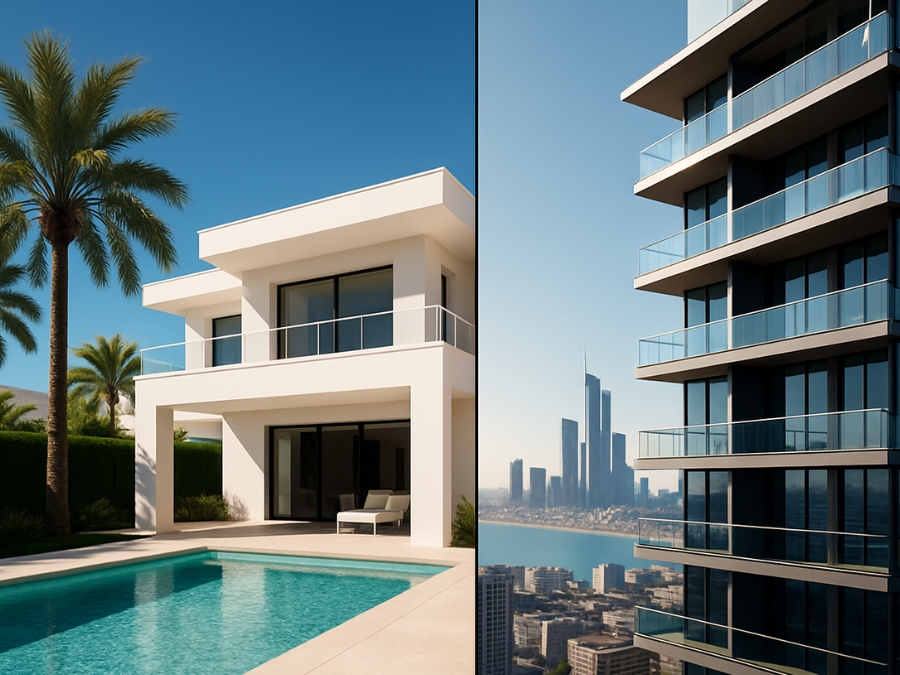
The Abu Dhabi real estate market is currently one of the world’s most dynamic, with the residential sector recording an impressive 17% annual price growth
. However, a closer look at the data reveals a significant divergence in performance between property types, leading to a critical question for investors: Is the future of capital appreciation in the Emirate found in high-rise apartments or sprawling villas?
The answer lies in a striking statistic: villas have delivered a staggering 42.3% outperformance compared to the wider market
. This dramatic gap highlights a fundamental shift in buyer preference and market dynamics, making the choice between a villa and an apartment the most crucial decision for any prospective investor in Abu Dhabi.
The Post-Pandemic Premium: Why Villas Outperform
The 42.3% outperformance of villas is not merely a statistical anomaly; it is a direct consequence of several powerful, interconnected market forces that have accelerated since 2020.
1. The Quest for Space and Luxury
The global trend toward larger living spaces, driven by remote work and a greater focus on quality of life, has been amplified in Abu Dhabi. High-net-worth individuals (HNWIs) and affluent families are prioritizing privacy, dedicated home offices, and outdoor areas. This has created intense demand for standalone villas, particularly in exclusive, master-planned communities. This demand has pushed the luxury segment to new heights, with projected price growth for Luxury Villas in 2025 estimated at 10-12%
.
2. The Influx of Global Capital
Abu Dhabi’s appeal as a safe haven, combined with its tax-free environment and robust economy, has attracted significant international capital
. These foreign investors and new residents often seek high-end, ready-to-move-in properties that serve as both a primary residence and a stable store of wealth. Villas, especially those in freehold zones, fit this profile perfectly, leading to intense competition and rapid price escalation.
3. Scarcity in Prime Locations
Unlike apartments, which can be built vertically, the supply of prime land for villa development is inherently limited. This scarcity ensures that as demand continues to be fueled by population growth and foreign investment
, the capital appreciation for existing villas remains exceptionally strong.
The Case for Apartments: Stability and Yield
While villas dominate the narrative of capital appreciation, apartments remain the bedrock of the market, offering a different, yet equally valid, investment profile.
Apartments cater to a broader segment of the market, including young professionals, smaller families, and investors focused on steady rental income. The projected price growth for Affordable and Premium Apartments in 2025 is a healthy 6-8%
. This growth, while more moderate than the villa segment, reflects a stable and mature market.
The primary advantage of apartments is their potential for higher rental yields and greater liquidity. The continuous influx of expatriate workers ensures a strong, consistent demand for rental units, particularly in centrally located areas. For an investor prioritizing cash flow and a lower entry point, apartments offer a compelling proposition.
Investment Strategy: Capital Growth vs. Rental Income
The decision between a villa and an apartment ultimately hinges on the investor’s primary goal. The following table summarizes the key trade-offs:
Feature | Villas (Capital Growth Focus) | Apartments (Rental Income Focus) |
Primary Driver | Capital Appreciation (42.3% outperformance) | Rental Yields and Steady Cash Flow |
Entry Point | High (Requires significant capital) | Moderate to Low (More accessible) |
Risk Profile | Higher (More sensitive to economic cycles) | Lower (Broader tenant base, stable demand) |
Liquidity | Lower (Fewer buyers, longer sales cycle) | Higher (Larger pool of buyers and renters) |
Target Investor | High-Net-Worth Individuals, Long-Term Investors | Mid-Range Investors, Cash-Flow Seekers |
Location is the Ultimate Arbitrator
Regardless of the property type, location remains paramount. The most spectacular returns are often found where luxury property meets strategic development.
For instance, the hyper-growth seen in the villa segment is often concentrated in master-planned communities like Saadiyat Island, Yas Island, and Al Reem Island. These areas benefit from world-class infrastructure and lifestyle amenities
. The most telling example is the 69% price surge in waterfront properties
, which are predominantly high-end villas and luxury apartments. Investing in these prime locations, where scarcity and desirability converge, is key to maximizing returns, regardless of whether the property is a villa or a premium apartment.
Tailoring Your Investment
The 42.3% outperformance of villas in Abu Dhabi is a clear signal that the luxury and space segment is currently the engine of capital growth. For investors with significant capital seeking maximum appreciation over the long term, the villa market offers unparalleled returns.
However, for those seeking a more accessible entry point, lower risk, and consistent cash flow, the apartment market provides a stable and profitable alternative with healthy projected growth. By understanding the distinct drivers of each segment—the luxury-driven capital appreciation of villas versus the yield-driven stability of apartments—investors can tailor their strategy to capitalize on Abu Dhabi’s booming real estate landscape.