
Supply vs. Demand: Navigating Abu Dhabi's Market Where Demand Outpaces New Units
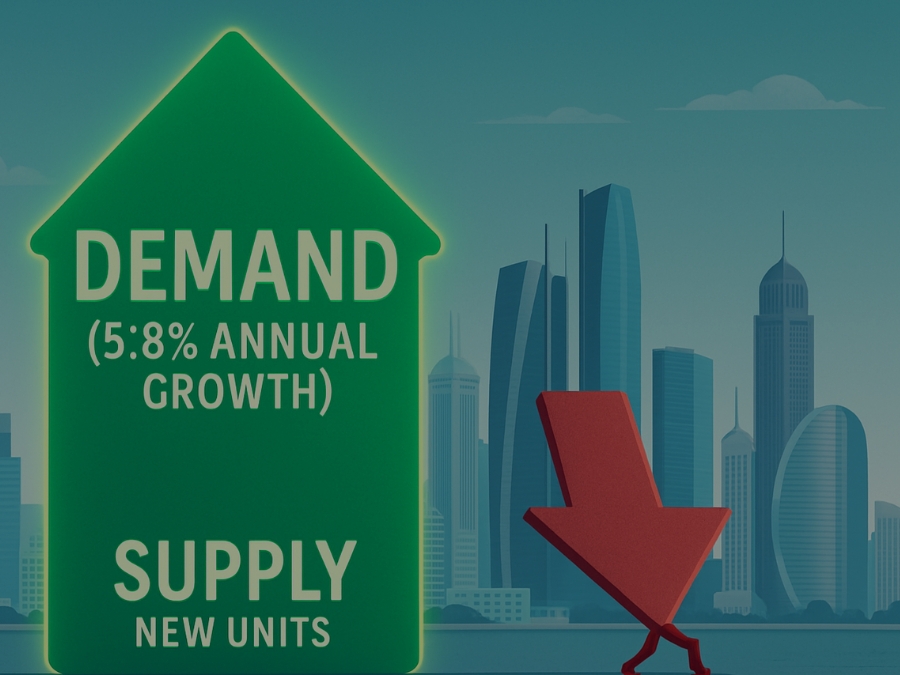
The Abu Dhabi real estate market is currently experiencing a period of robust growth, with prices soaring and transaction volumes hitting record highs. While many factors contribute to this boom, the most fundamental driver is a classic economic principle: a significant and persistent imbalance between supply and demand.
This dynamic is creating a unique environment where scarcity is fueling exceptional price appreciation, presenting a golden opportunity for savvy investors. This article analyzes the current market dynamic, explains the forces behind the surge in demand, and outlines how investors can strategically capitalize on the resulting market conditions, particularly in the off-plan sector.
The Critical Imbalance: 5.8% Demand Growth
The core of Abu Dhabi’s current market strength lies in the sustained appetite for residential property. Between 2022 and the first half of 2025, residential demand across the Emirate grew at an average annual rate of 5.8% . This figure is a powerful indicator of the city’s increasing desirability as a place to live and invest.
However, the delivery of new residential units has not kept pace with this accelerating demand. While new projects are continually being launched, the time required for construction means that the available supply of ready-to-move-in properties, and even properties nearing completion, is severely constrained.
This supply-demand gap is the primary mechanism driving the overall market’s appreciation, which has seen annual residential price growth top 17% .
The Engines of Demand: Why Everyone Wants a Piece of Abu Dhabi
The 5.8% annual growth in demand is not a temporary spike; it is a structural shift driven by long-term government policies and global economic trends:
1. Population Growth and Economic Diversification
Abu Dhabi’s strategic vision for economic diversification has successfully attracted a large influx of skilled expatriates and new businesses. This sustained population growth creates a constant, organic need for housing. The government’s focus on non-oil sectors, including technology, finance, and culture, ensures that this demand is high-quality and long-lasting.
2. The Safe Haven Effect
In an era of global uncertainty, Abu Dhabi is widely regarded as a safe haven for capital. The Emirate’s political stability, strong legal framework, and tax-free environment make it an ideal location for HNWIs to preserve and grow their wealth . This has led to a significant increase in foreign investment, with international buyers making up a substantial portion of transactions in prime areas .
3. Quality of Life and Infrastructure
The continuous development of world-class infrastructure, including new cultural institutions, entertainment hubs, and master-planned communities, enhances the overall quality of life. This makes Abu Dhabi an increasingly attractive place for families to settle long-term, converting transient renters into permanent homeowners and further tightening the market.
Capitalizing on Scarcity: The Off-Plan Opportunity
The supply-demand imbalance creates a particularly compelling opportunity in the off-plan segment—properties sold before or during construction.
Investment Segment | Supply-Demand Impact | Investor Strategy |
Ready Properties | High scarcity, immediate price appreciation, high entry cost. | Focus on immediate rental yield and short-term capital gains. |
Off-Plan Properties | Allows investors to secure a unit at today’s price before the supply gap is closed. | Focus on long-term capital appreciation and securing prime locations. |
Investing in off-plan properties allows investors to lock in a price that reflects the current market, while the property’s value is expected to appreciate significantly by the time of handover, driven by the persistent demand. Furthermore, developers often offer attractive payment plans, making the initial capital outlay more manageable.
This strategy is particularly effective in high-growth areas like Saadiyat Island and Yas Island, where the combination of limited land and high desirability ensures that the value of new units will continue to climb as the market matures.
Conclusion: A Seller’s Market with Investor Potential
The Abu Dhabi real estate market is defined by a critical supply-demand imbalance, with demand growing at a robust 5.8% annually and consistently outpacing the delivery of new units. This dynamic is the engine of the current price appreciation and creates a strong seller’s market.
For investors, this scarcity is not a barrier but an opportunity. By strategically targeting the off-plan segment and focusing on high-demand locations, investors can effectively capitalize on the market’s inherent momentum, securing assets that are poised for substantial capital growth as the Emirate continues its ascent as a global economic and residential hub.
Join The Discussion