
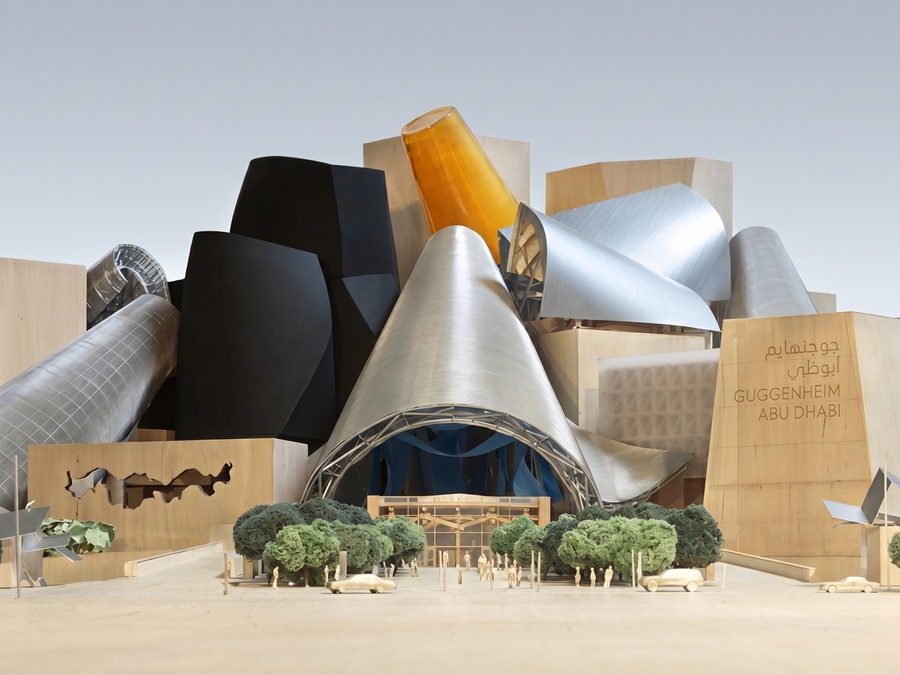
Twenty Years. One Building. A Permanent Shift.
First announced in 2006, constructed from 2011, paused, restarted in 2019, and now nearing its long-anticipated completion on the northwestern tip of Saadiyat Island — the Guggenheim Abu Dhabi has been the most consequential unfinished story in the emirate’s cultural development for two decades. In February 2026, Anwar Gargash, diplomatic advisor to the UAE President, confirmed on X that the project is “nearing completion” with opening anticipated this year. The Solomon R. Guggenheim Foundation’s director Richard Armstrong confirmed 2026 as the target opening year at a press conference in Basel.
When it opens, the Guggenheim Abu Dhabi will be the largest museum in the Guggenheim Foundation’s global network, covering 42,000 square metres across a peninsula site with views of the Arabian Gulf on three sides. It is also the final major project designed by Frank Gehry, who passed away in December 2025 at the age of 96 — giving the building a historical significance that no future cultural institution can replicate. For Saadiyat Island property investors, the opening does not just add another amenity to an already strong location. It completes a cultural district that has been building toward this moment for twenty years.
What the Guggenheim Abu Dhabi Actually Is
Understanding the investment implications requires understanding the scale and ambition of what is being built. This is not a regional museum. It is the flagship institution of the world’s most recognised contemporary art foundation, designed by one of the most celebrated architects in history, positioned as the anchor of a cultural district that includes the Louvre Abu Dhabi, the Zayed National Museum, the Natural History Museum Abu Dhabi, and the Abrahamic Family House.
| Key Facts | Detail |
| Full name | Guggenheim Abu Dhabi |
| Developer and operator | DCT Abu Dhabi and Solomon R. Guggenheim Foundation |
| Architect | Frank Gehry (Pritzker Prize laureate, 1989) |
| Total floor area | 42,000 sqm (approximately 320,000 sqft) |
| Status within Guggenheim network | Largest of the four Guggenheim institutions globally |
| Other Guggenheim locations | New York, Bilbao, Venice |
| Location | Northwestern tip of Saadiyat Island, Abu Dhabi |
| Construction contractor | Six Construct (BESIX Group) and Trojan General Contracting JV |
| Construction contract awarded | October 2021 |
| Anticipated opening | 2026 (no specific date officially confirmed) |
| Permanent collection | 600 works focusing on art from 1960s to present |
| Regional focus | West Asia, North Africa, and South Asia |
| Additional facilities | Research centre, conservation laboratory, children’s education facility, library |
The architectural language Gehry brought to the project is unmistakably his but contextually rooted. Asymmetric cone-shaped structures inspired by the UAE’s traditional wind towers serve as both entrances and exterior exhibition spaces. The placement on a peninsula allows natural light and Gulf views to penetrate the building on multiple axes simultaneously. The result, based on construction photographs circulating since December 2025, is a building that matches the ambition of its two-decade development timeline.
The Cultural District Is Now Complete
The Guggenheim’s opening transforms Saadiyat Island’s Cultural District from a partially realised vision into a fully operational world-class cultural precinct. That transition is the most significant change in the island’s residential investment case since the Louvre Abu Dhabi opened in 2017.
| Institution | Status |
| Louvre Abu Dhabi | Open since 2017 |
| Abrahamic Family House | Open since 2023 |
| teamLab Phenomena Abu Dhabi | Open since 2024 |
| Natural History Museum Abu Dhabi | Open since 2025 |
| Zayed National Museum | Open since 2025 |
| Guggenheim Abu Dhabi | Anticipated 2026 |
The Louvre’s 2017 opening already demonstrated the direct relationship between cultural institution openings and Saadiyat residential values. In the two years following the Louvre launch, prime Saadiyat apartment prices rose measurably as international awareness of the island’s cultural positioning accelerated. The Guggenheim operates on a different order of magnitude. Where the Louvre added one major institution to the island, the Guggenheim completes the entire Cultural District framework and does so as Frank Gehry’s last building, with the global architectural and cultural press attention that designation generates. For buyers evaluating luxury property investment on Saadiyat Island, the 2026 window represents the last point at which this opening has not yet been fully priced into the market.
Why Saadiyat’s Investment Case Is Now Structurally Different
Abu Dhabi’s Saadiyat Island already led the emirate’s transaction period between March 1 and April 13, 2026, generating AED 4.35 billion in residential sales — 23.5% of Abu Dhabi’s total transaction value across all districts in that window. Apartment capital values on the island grew 32% year-on-year in Q1 2026 per Colliers’ data, and the island consistently commands Abu Dhabi’s highest residential price-per-sqft across both villa and apartment segments.
The Guggenheim’s opening strengthens three specific demand drivers that underpin those figures. First, international cultural tourism to Saadiyat will expand meaningfully. The Guggenheim attracts a category of visitor — the museum-motivated, high-net-worth cultural tourist that the Louvre, teamLab, and the Zayed Museum collectively amplify but that the Guggenheim definitively anchors at global brand recognition level. Second, the short-term premium rental market on the island gains a permanent new demand driver. Cultural institution visitors plan trips and accommodation around opening seasons, exhibitions, and special events creating recurring high-demand periods beyond the UAE’s existing tourism calendar. Third, Saadiyat’s scarcity premium becomes permanent. A cultural district of this calibre, once complete, cannot be replicated elsewhere in Abu Dhabi. The land, the institutions, the architectural heritage, and the global recognition are fixed to this specific island address in perpetuity.
Gehry’s Last Building: A Dimension No Future Project Can Claim
There is one aspect of the Guggenheim Abu Dhabi’s investment case that is entirely unique and entirely irreversible. Frank Gehry the architect who defined what a cultural institution building could be through the Guggenheim Bilbao in 1997, and who spent nearly two decades shepherding this project through its delays — died in December 2025 at the age of 96, without seeing his final major building completed.
The Guggenheim Abu Dhabi is now his posthumous masterpiece. That designation carries implications that extend well beyond architectural appreciation. Buildings that become posthumous landmarks for architects of Gehry’s stature attract a specific, sustained layer of global cultural attention that buildings by living architects simply do not generate. The Bilbao effect — the measurable economic and social transformation of a mid-sized Spanish city attributed directly to the Guggenheim Bilbao’s 1997 opening has been studied, referenced, and cited for nearly three decades. Abu Dhabi has deliberately built toward its own version of that transformation on Saadiyat Island for twenty years.
Conclusion
The Guggenheim Abu Dhabi’s anticipated 2026 opening is the single most significant cultural event in Abu Dhabi’s history and the most consequential demand driver for Saadiyat Island residential property in the island’s development story. Twenty years in the making, designed by the architect who defined what a cultural institution building could achieve globally, positioned within a completed Cultural District that already includes the Louvre and four other world-class institutions, and carrying the irreplaceable distinction of being Frank Gehry’s final major work. For investors who understand that cultural infrastructure is the most durable residential demand driver available, and who have not yet secured a position on Saadiyat Island, 2026 is the last chapter in which this opening has not yet been fully reflected in prices.
The opening is anticipated in 2026. Anwar Gargash, diplomatic advisor to the UAE President, confirmed in February 2026 that the project is “nearing completion” with opening anticipated this year. No specific date has been officially confirmed by DCT Abu Dhabi or the Solomon R. Guggenheim Foundation. Explore Saadiyat Island properties ahead of the opening.
It completes Saadiyat Island’s Cultural District after twenty years, adds the world’s most recognised contemporary art brand to the island’s permanent identity, and operates as the final major work of Frank Gehry — a designation that generates a specific, sustained category of global cultural attention that no future project can replicate. Saadiyat already led Abu Dhabi’s transaction period in early 2026 with AED 4.35 billion in sales.
The museum covers 42,000 square metres, making it the largest institution in the Solomon R. Guggenheim Foundation’s global network — larger than the Guggenheim New York, Bilbao, and Venice combined. It includes a permanent collection of over 600 works focused on art from the 1960s to the present, alongside a research centre, conservation laboratory, and children’s education facility. Get expert property investment advice in Abu Dhabi on positioning ahead of this opening.
Frank Gehry designed the building, drawing inspiration from the UAE’s traditional wind towers through asymmetric cone-shaped structures that serve as entrances and exterior exhibition spaces. Gehry, who won the Pritzker Prize in 1989 and designed the Guggenheim Bilbao, passed away in December 2025 — making this his final major project and posthumous masterpiece.
The Saadiyat Cultural District includes the Louvre Abu Dhabi (open since 2017), the Abrahamic Family House (2023), teamLab Phenomena Abu Dhabi (2024), the Natural History Museum Abu Dhabi (2025), the Zayed National Museum (2025), and the Guggenheim Abu Dhabi (anticipated 2026). Browse Saadiyat Island’s full residential offering to find the best available properties within this cultural district.
Join The Discussion